

This article was written by The Zillennial Zine’s spring editorial intern Henry Ryeder. Find him on Instagram at @henryryeder. If you would like to share an article with The Zillennial, send us an email at thezillennialzine@gmail.com.
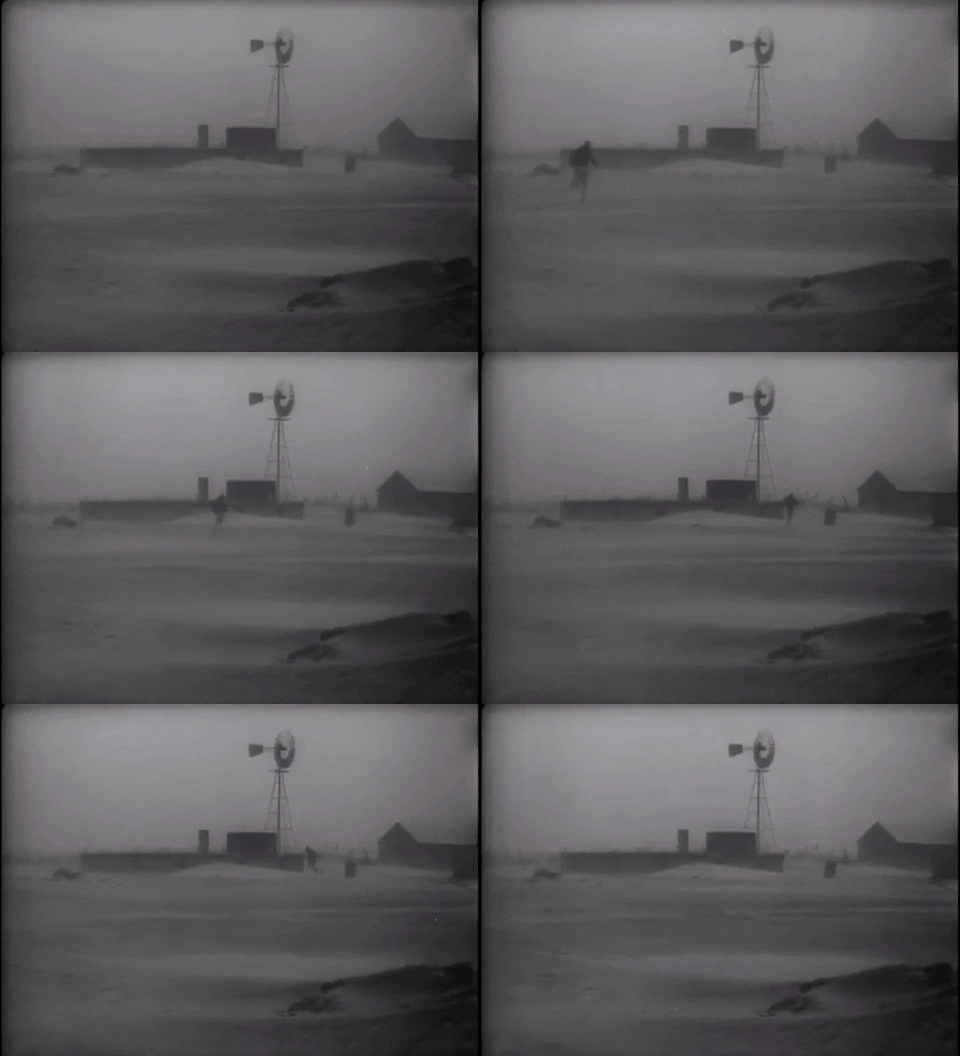
March 21, 1935. Esteemed conservationist Hugh Bennett was testifying before Congress. After a previous day of speaking on the Capitol floor to a group of tired senators, Bennett was nearing the end of his plea. The Dust Bowl, a human-caused ecological disaster unfolding in the Midwest, was an emergency. Though the United States was facing threats at home (an economic depression wreaking havoc on millions) and abroad (the rise of global fascism), the farmers’ plight was undoubtedly a disaster. America’s bread basket was in jeopardy, and with it, millions of farmers who called the region home.
Bennett, in charge of the Soil Erosion Service, was making his case that without additional funding, the crisis in the Midwest would only worsen. Bennett was no fool; he’d been studying agricultural science his entire life. Not long before his scheduled Congressional appearance, Bennett was informed that a mammoth dust storm would sweep east and hit Washington D.C. on March 21. He timed it perfectly. Still in the middle of a long, rambling speech, several senators began to notice a large cloud of dust enveloping the nation’s capital. It approached slowly but surely, blotting out the sun and leaving the sky a copper color. Bennett was perhaps too politically inclined to take a messianic turn in his speech, opting for a polite confirmation that “it does look like dust.”
Readers will probably find that the above description bears an eery resemblance to another human-caused ecological disaster. In early June of last year, wildfire smoke from Quebec poured over the East Coast. Many politicians, including Senator Bernie Sanders from Vermont, took to social media to show the sky seemingly ablaze above Washington. “I’ve got bad news for you. It’s only going to get worse. And our job now is to everything we can to wake up this Congress…to demand that we fundamentally transform our energy system away from fossil fuel…”

Sanders was right…about that. CO2 levels are now at the highest levels since the Industrial Revolution. Records in Antarctic ice cores contain information on atmospheric CO2 levels going back over 800,000 years. Just over the past eight months, global CO2 levels rose a relatively massive 10 parts per million; a 2% jump. What kind of well-intentioned march toward progress necessitated this amount of fossil fuel? Take a guess.
I know the state of the world right now is dismal, and that’s putting it lightly. It seems as though we’re heading to hell and we don’t even get the damn hand basket. And you’d be justified in assuming that the rest of the article would project the worst image possible; that a second Dust Bowl is likely. Before sitting down to write this article, that’s what I thought the research would show.

I’m happy to inform you that it doesn’t have to be that way. The first Dust Bowl stemmed from human error in the face of environmental reality. The reality is that the weather in the Great Plains is highly unpredictable. Long periods of rain are followed by long periods of drought. The human error was greed. Land speculators sold opportunistic farmers on cheap land, urging them to dig up the region’s natural prairie grass to till the land for crop-growing. The subsequent deforestation and disruption seemed safe during periods of steady rainfall, when the soil retained moisture and supported crop growth.
But 1930 brought an 11 year period of drought that devastated the region. Without moisture, 100 million acres of topsoil dried up, turning into dust. These large black clouds of dust caused severe respiratory problems, wrecked homes and livelihoods, and caused a mass-migration that would be romanticized (exploited?) brilliantly by author John Steinbeck. The problem was curbed slowly but surely by government-sponsored soil conservation and irrigation efforts on an unprecedented scale. These better practices, in conjunction with the long-awaited end of the drought in 1940, closed the chapter on the first Dust Bowl.
Will there be another Dust Bowl? It’s not certain. Rising temperatures from Climate Change have caused a record drought in the Midwest. Without proper protective measures, the stage will certainly be set for another Dust Bowl in the future. However, it doesn’t have to happen. It may not seem like it, but we have come a long way since the 1930’s. Though we may not show it in our decision-making, we know more about our impacts on the environment. Better farming practices that involve acknowledging nature’s dominion can help avert dangerous and destructive methods.
About a week ago, my little brother gave me the idea for this article. He told me that he was driving through Ohio, noticing all the dust in the valleys, and Googled “Will there be another Dust Bowl?” Apparently, he was greeted to a litany of headlines projecting another Dust Bowl within the next 50 years. I couldn’t find anything like that when doing research for this piece, and I’m glad I didn’t. While it drives revenue, apocalypse bait demotivates us. If you’ve read some of my other work for Zillennial, you’ll probably have picked up on this. “Doomerism” is an easy out; it gives us an answer when the path forward feels so uncertain.
I can’t tell you there won’t be another Dust Bowl. But I can tell you that there doesn’t have to be one. Like all these disasters that our leaders and dictators placed on our shoulders, Climate Change isn’t stronger than our will to fight it. We wouldn’t be marching in the streets for Palestine, women’s rights, or access to medical care if our better instincts didn’t matter. They do. Global CO2 levels would reduce by half of what human beings contributed within just 30 years of reaching Net Zero. The man so desperate for the youth vote could end the genocide in Palestine with a phone call. We know that we’re capable of destruction. We should also know that we’re capable of regrowth.
Do you think another Dust Bowl is coming? Leave a comment below!


Leave a Reply