

This article was written by The Zillennial Zine’s spring editorial intern Henry Ryeder. Find him on Instagram at @henryryeder. If you would like to share an article with The Zillennial, send us an email at thezillennialzine@gmail.com.
December, 2020. Nearly eight months into the COVID-19 Pandemic, and just days after the results of the presidential election in Pennsylania had spelled the end of Donald Trump’s first term, Tik Tok was a buzz. One would be forgiven to assume that any major portion of the Tik Tok contingent would be fixated on politics, public health, or environmental catastrophe. Instead, Tik Tok was enraged at a war criminal.
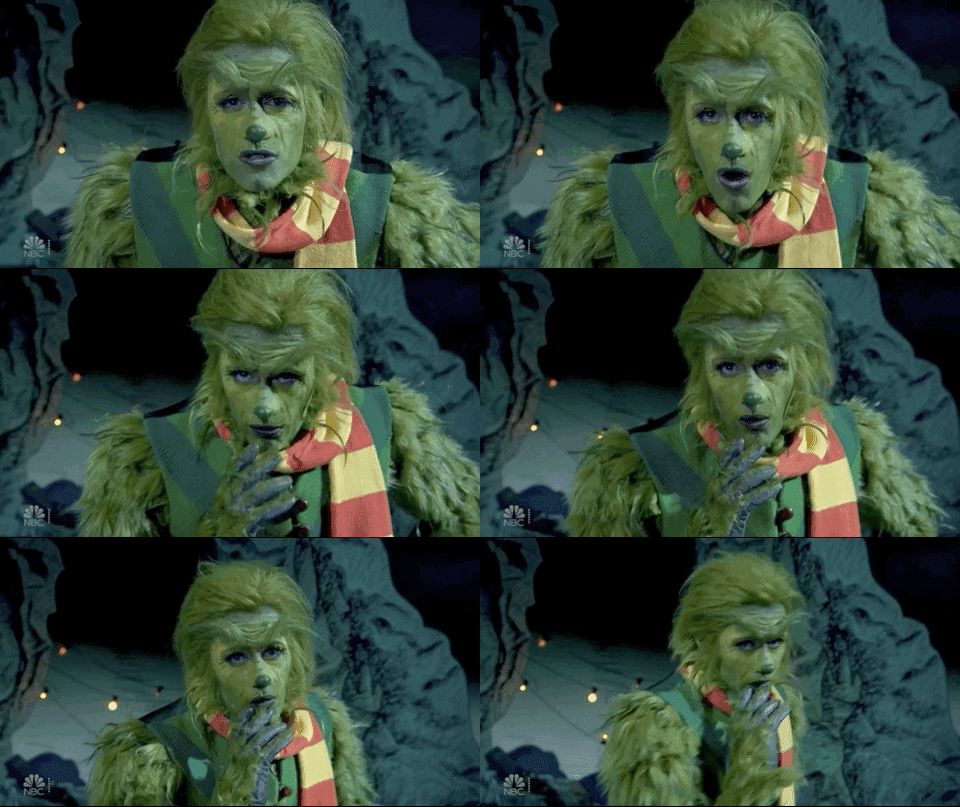
Well, not an actual war criminal. Matthew Morrison, best known to the world as Will Schuester, the head of a high school glee club on Fox’s Glee, had recently been cast as the lead in a live broadcast of Dr. Seuss’s The Grinch Musical. What could possibly be the big deal? How could he be a WAR CRIMINAL!?
Here’s a brief summary of some of the actions that blonde, curly-haired Matthew Morrison performed as a high school teacher in the first few seasons of Glee:
- Sing and dance to Bust A Move while fondling a student’s face
- Sing The Thong Song and aggressively dance up on another man’s fiancé in her bridal gown
- After learning about racial inequity, tell his students that they’re “all minorities” because they’re in the glee club
- Break up that woman’s relationship, then immediately cheat upon learning about that woman’s virginity
- Spitefully seduce the captain of the cheerleading team by reminding her that Wednesday is “hump day”
- In an effort to win back the woman whose marriage he foiled and whom he cheated on, make the high school students perform a production of The Rocky Horror Show in which he forces students to be barely clothed, then cast himself in the production to perform in his underwear
- Dance and perform a highly suggestive version of Toxic by Britney Spears with his high school students to an audience exclusively comprised of high school students
- Dress up in a caricature of a mariachi outfit and sing in a cartoonish Latin American accent
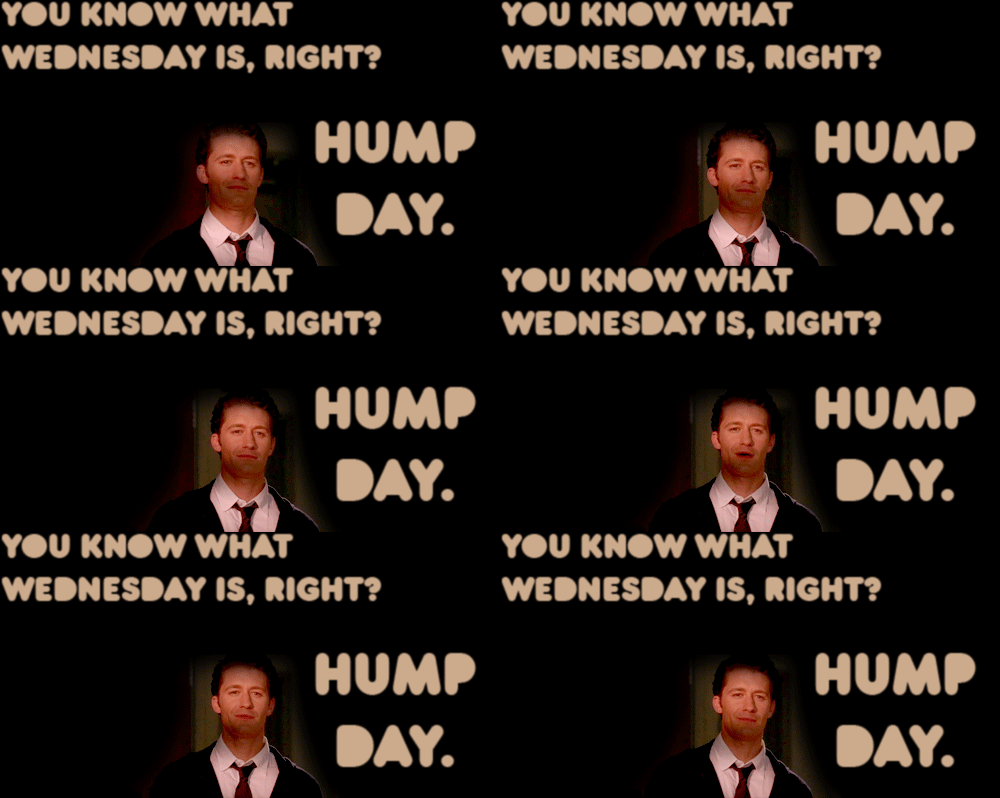
If any of the above is surprising to you, you probably haven’t seen the monstrosity that is Glee. In a normal case, I’d be compelled to tell you to watch the show so that the rest of this article makes sense. But honestly, I think that would be an ethical violation of just about every role I have as a writer and human being. For those still reading, you’ve found yourself an ally and fellow inmate in the eternal paradise and prison of Glee viewership.
Glee ran for six seasons on Fox between 2009 and 2015. As the years go on, Glee finds new ways to entertain as the show’s most problematic moments become more obvious. In its facile understanding of its characters and the issues it shamelessly portrays, Glee reminds us that no matter how bombastically unsympathetic our media, institutions, and country may be, they will always remain convicted of their own righteousness.
Glee was the brainchild of co-creator Ian Brennan, whose experiences in a high school glee club in Illinois led him to write a feature screenplay. Brennan’s friend Brad Falchuk voiced the idea to his friend Ryan Murphy at a gym in Los Angeles, where Murphy jumped at the idea of producing the script for episodic television.
While Brennan and Falchuk share equal co-creator credits, Ryan Murphy is the alpha and omega of Glee A journalist-turned soap television darling with Popular and Nip/Tuck, Murphy was already a legend of camp tour-de-force by 2008. How Murphy did and didn’t pay attention to members of the cast throughout the show’s tenure is worthy of its own article. Needless to say, the buck stopped with Ryan Murphy on Glee.
In finding a through-line for Season 1, the show writers settled on making Matthew Morrison’s Will Schuester its leading man. Watching Season 1 of Glee knowing where the show will eventually go is quite the riot. Will Schuester is a terrible character right out of the gate. Condescending, misogynist, self-absorbed, and oh… oh so horny… Schue commands the screen less with his presence than his confidence, strutting his body to some of the most embarrassing rap moments in the history of television. The sheer amount of screentime afforded to Morrison’s character in Season 1 is only matched in repulsion by the story world’s reaction to him. Women are constantly throwing themselves at Will Schuester… as well as high school students. This last bit plays out in one of the most cringe-worthy and controversial Glee episodes, in which Lea Michele’s 16-year-old Rachel Berry and Jayma Mays’s guidance counselor Emma Pillsbury swoon over Will singing the opening line of The Police’s Don’t Stand So Close To Me, “Young teacher, the subject, of school girl fantasies.”
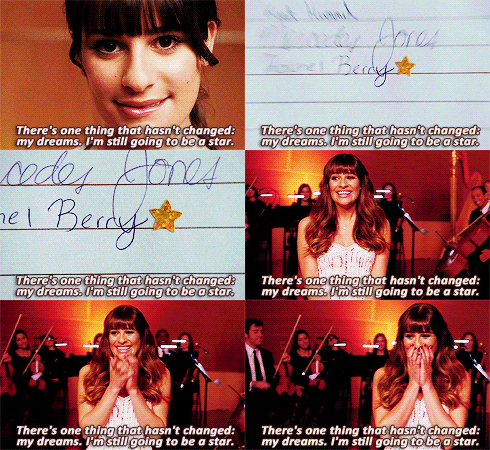
Unfortunately for Morrison, Glee’s instant success coinciding with the internet age allowed the showrunners to tailor Season 2 to fans’ wishes, all while keeping Murphy’s cast preferences in mind of course. Sensing the overwhelming teen audience, Season 2 became a show almost entirely about the students. One of these students was the obvious favorite of Murphy, Rachel Berry, played by Lea Michele. Michele was another Broadway regular by the time of her casting, and had spent perhaps a little too much time on the Great White Way. A breakout star from Spring Awakening, Michele’s audition tape for Glee infamously includes her scolding her pianist to “go back to the second verse” when he mistakingly plays a wrong section. “That wasn’t supposed to be funny… you were supposed to cry,” Michele says after an audience (presumably the show runners) offer some laughter. This energy is the ticking clock of Rachel Berry, and therefore, the ticking clock of Glee.
Rachel is one of the most terrifying characters on network television, showing practically no remorse or empathy for others while feigning that her actions are merely an expression of love for the glee club. All of this sociopathic angst is captured in Michele’s unyielding smile, a truly terrifying and mesmerizing expression that impossible to look away from. All of this is probably best personified in my favorite moment from Glee in Season 2, in which Rachel has a sing-off with guest star Jake Zyrus’s Sunshine in a bathroom, shortly before tricking Sunshine into driving to a crackhouse. This baroque dizzyspell unfortunately begins with one of Glee’s most offensive jokes, during which Rachel thinks that Asian-American Sunshine is unable to speak English. At least we know Lea can speak English, even if her literacy is in question.
Racism is both one of the Glee’s most favorite topics and one of its most heinous crimes. Amber Riley’s Mercedes, the show’s only Black series regular, is largely ignored plot-wise for most of the series, used only exploitatively during the show’s biggest numbers for her spellbinding voice. Mercedes is also an offensively stereotypical and poorly-written character, shown desiring unhealthy foods and paired up with Chris Colfer’s Kurt Hummel because they’re socially excluded (and we all KNOW Black and queer experiences are essentially the same thing.)
Queerness is its own can of worms on Glee. Though Murphy certainly has his own queer experiences to pull from, queerness is repeatedly shown on Glee as only serious when experienced by cis white men. Much of Kurt’s queerness is shown as being actively dangerous to him, straining his relationships with his family and his friendships, with brief moments of Manic Pixie resolution offered up by a pretty milquetoast Blaine, portrayed by Darren Criss. The one queer relationship that’s cited as being legitimately boundary-pushing on Glee is that between Naya Rivera’s Santana and Heather Morris’s Brittany. While the relationship between these two cheerleaders at first seems written in to provide a sexual fantasy to motivate the straight male characters, Santana and Brittany’s relationship eventually blossoms into a legitimate coupling in Season 3, resulting in an iconic (not to mention insanely ridiculous) Fleetwood Mac cover.
Yet the queer reveal wasn’t the only drama that Naya Rivera was serving on Glee. Naya Rivera’s epic feud with Lea Michele (with whom most colleagues have seemed to have well-documented epic feuds) spilled over onto tabloid and fandom gossip by Season 2. This was fueled by Murphy’s own direction; in the series Rivera and Michele’s characters constantly bicker over their value and attractiveness in the club and in their school. Yet in an interview at the time, Murphy seemed to sidestep criticism of his pushing a feud for entertainment value, instead implying that journalists don’t cover the real drama happening with the men. “You don’t hear anything about the boys’ fighting.”
Here’s the part where the real-world tragedy of the show feels necessary to explain. Though these terrible events have been painstakingly (if not well) documented, they provide necessary context for understanding Glee’s continued cultural prominence. Three regular cast members of the show died horrific deaths within a short span of seven years. Cory Monteith who portrayed Finn Hudson, the show’s de facto leading man after Matthew Morrison’s role was diminished in Season 2, died of an overdose in 2013. Mark Salling, who portrayed mohawk-sporting bad boy Puckerman, took his own life prior to sentencing on charges of obtaining child pornography on his hard drive. Naya Rivera, who portrayed Santana Lopez, drowned in a boating excursion with her son Josey (who survived.)
It feels strange discussing the horrendous nature of the Glee cast deaths back to back. Their media treatment alone is similar to the clumsiness that Glee expressed while trying to handle weighty topics. That the deaths of a convicted child pornographer and a mother who drowned trying to save her son could be talked about in the same breath as a “curse” is patently obscene. It also speaks to our media’s willingness to forego reality for a narrative that sells, and that’s just about as Glee as it gets.
Glee wants to say everything, ends up saying very little, and ultimately leaves us at once confused and “icked.” In that, it’s similar to a lot of media that’s presented to us on a silver platter today, but at least Glee’s shit show is entertaining to watch.
I’ll end this article, as I should, with a quote from Matthew Morrison. In his early days, Morrison was a dancer and singer for “multi-cultural” boy band LMNT. Needless to say, this was not Morrison’s calling. In an interview about this time in his life in 2010, Morrison explained, “It was the worst year of my life. You know when you’re a performer and you’re out there on stage and you’re embarrassed that you’re doing something wrong.” That Morrison was self-aware enough to comprehend this idea, yet unable to apply this lesson to his war crimes as Will Schuester, is Glee in a nutshell.
What are your favorite Glee problematic moments? Let us know in the comments below!


Leave a Reply