

This article was written by The Zillennial Zine’s spring editorial intern Henry Ryeder. Find him on Instagram at @henryryeder. If you would like to share an article with The Zillennial, send us an email at thezillennialzine@gmail.com.
When sitting down to write this piece, I had the luck of finding an article in the New York Times. The paper of record (when it’s convenient) published a piece yesterday that took many of the words I was planning on writing about Sam Levinson’s art right out of my mouth. Funnily enough, Levinson is never directly mentioned.
Even still, Dr. Natasha Degen’s “When Culture Becomes A TikTok Craze” summarizes so much of what’s made the Euphoria creator so famous. Degen writes that the marketing machine has taken over culture, becoming the main focus behind a product. As far as the subject of the promotion itself, “Few products can compete with such fanfare.” In the age of constant media inundation, the line between expression and promotion can become easily twisted. Degen makes the strong case that regardless of intent, engaging in the marketing machine of modern culture feeds right into the hands of those selling the product.
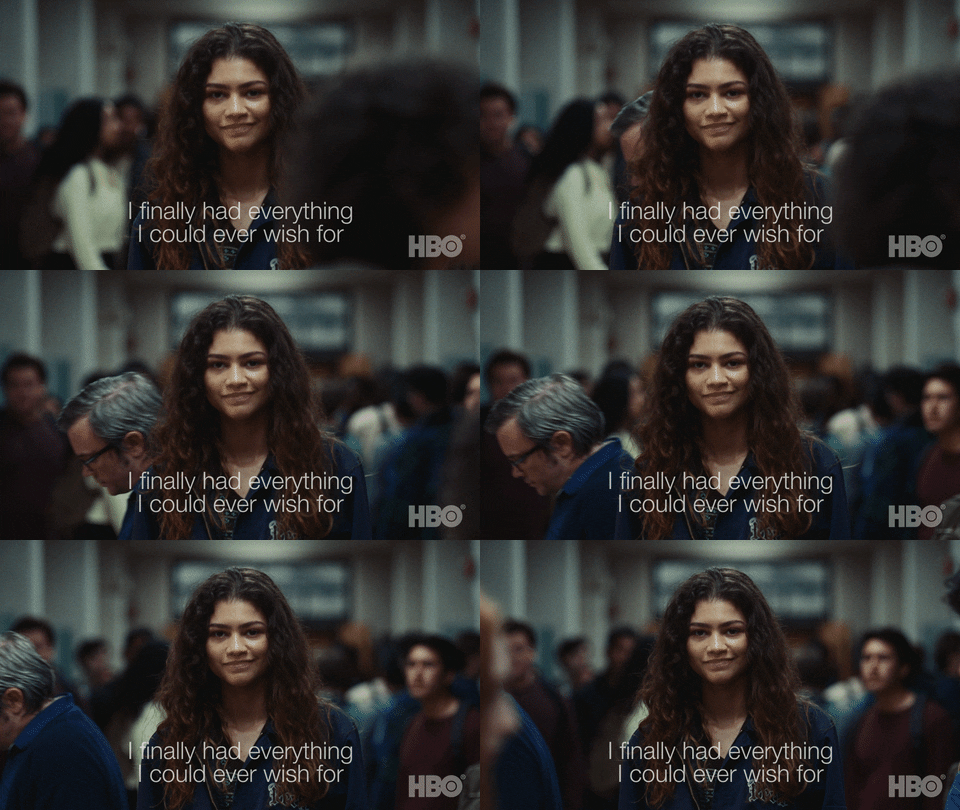
Which brings us to Sam Levinson. The son of Academy-Award winning director Barry Levinson, Sam Levinson has certainly known comfort and access in his life. He’s also inarguably dealt with hardship. The writer and director spent, according to him, a good deal of his teenage years in and out of rehab and halfway houses. Addicted to a vast array of substances, Levinson was convinced that drugs would take his life by the time he was 16. Levinson was luckily able to turn his life around, checked into rehab at age 19, and has been sober ever since.
This is a remarkable feat for any human being. Addiction is a lifelong struggle and one that demands empathy, patience, and the counsel of others. It’s also, as most anyone who struggles with addiction or knows someone who does will tell you, not an excuse for any and all poor life decisions that affect others. Those traits I just listed above are ones that, through recovery, Levinson has no doubt had to internalize in order to remain clean. Unfortunately, those traits don’t seem to carry over into his professional career.
It’s very difficult to say if Sam Levinson has worked particularly hard to attain the level of power he has in Hollywood. A podcast interview with IndieWire Toolkit made me genuinely respect the lengths that Levinson went to in order to provide the cast and crew of Euphoria with jobs during the doldrums of the pandemic. It also brought to my attention how much Levinson truly cares about his work.
Yet passion, for all its romantic glory, is no yellow brick road to talent, nor is it one to success. Levinson’s first high-profile feature length film, Another Happy Day, just happened to star Ellyn Burstyn, Demi Moore, and Kate Bosworth. The film received terrible reviews and grossed an abysmal box office revenue, even for an indie in 2011. Nevertheless, Levinson’s subsequent release in 2018, Assassination Nation, was produced by Hollywood impresarios David S. Goyer and Aaron L. Gilbert. The film made a splash on social media, thanks in part to its cast, which included supermodels Suki Waterhouse and Hari Nef, but failed to come anywhere close recouping its expenses. This was all before Euphoria, a television show whose first season’s production cost $165 million.
There’s a running theme here even before Levinson’s work became synonymous with the marketing apparatus of modern culture. Levinson always got what he wanted, even if what he wanted cost the top players in Hollywood tens of millions of dollars. It’s pretty evident that Levinson’s familial connections are the culprit to this economic discrepancy. The guy’s a Class-A Nepo Baby, and is able to leverage that power to make whatever big budget Hollywood project he wants. Unfortunately for the world, those projects only got more transparently exploitative as time went on.
There’s far too much going on in both seasons of Euphoria to put into one article, much less one paragraph. For critical context, I’ll simply summate a lot of discourse by saying that Euphoria has been derided and praised in equal regard, buoyed by its world famous star, and made tabloid fodder for its depiction of teenage sexuality and drug use.
Now onto what I consider so despicably entertaining about Euphoria. Like so many of the products listed in Degen’s article, Euphoria pales in comparison to the hype it creates. After watching all of Euphoria, it’s difficult to determine if there is any salvageable episode arc, any sensible beat, anything that speaks to something that works as television or film.
All that we’re left with is a fabricated aestheticized portrayal of teenage life that only gets more ridiculous as it goes on. The revolving door of romantic and drug-addled intrigue kicks into successively higher gears until Euphoria achieves some kind of impossibly frenetic homeostasis. If all of this sounds vague and unbelievable, it’s because that’s Euphoria in a nutshell. The delicious absurdity of it all is best exemplified in this scene, in which Cal, portrayed by a flaccid (in more ways than one) Eric Dane, pees on his mudroom rug and, member out, tells off his family for not accepting his sexuality as they themselves lead double lives. This scene’s lukewarm acting and trite, head-smashing dialogue underscores an uncomfortable truth about Euphoria‘s (and by-proxy Sam Levinson’s) success: a good deal of its prestige accolades simply come from the fact that it’s expensive.
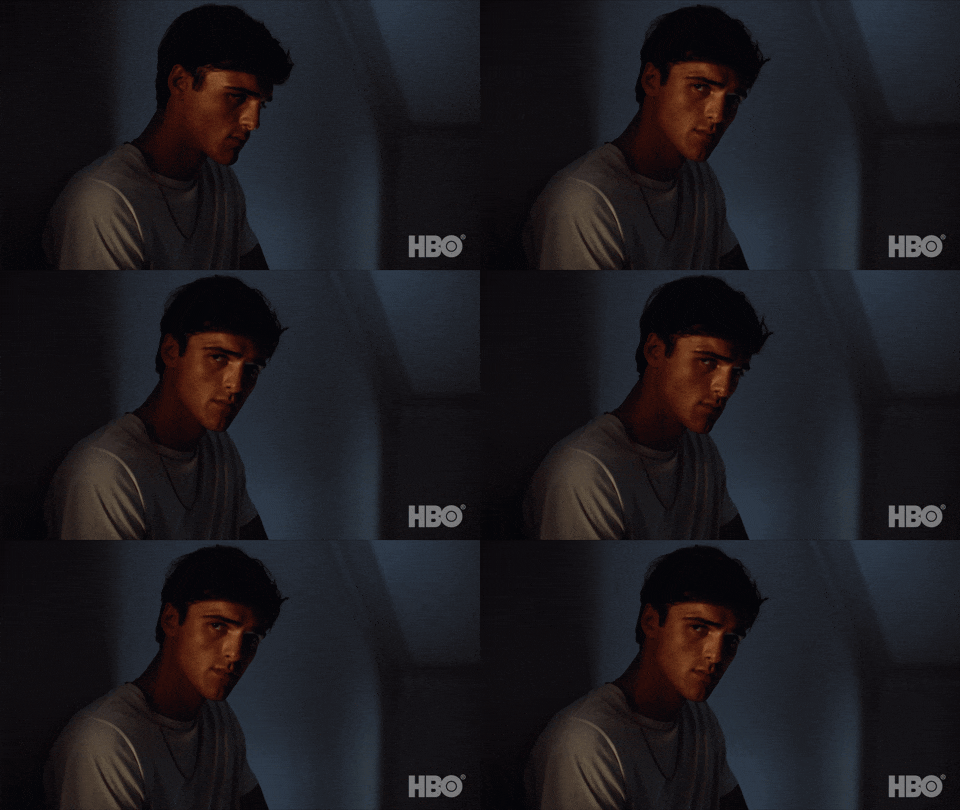
You might vehemently disagree, which I understand, but I invite you to imagine this scene, the scene in which Sydney Sweeney sings Sinéad O’Connor, the scene in which Jacob Elordi bangs his head against the floor, the scene in which a high school musical theater production ends in a simulated ejaculation, the scene in which a Dothraki warrior from Game of Thrones slays one teenager and has sex with another, the scene in which Dominic Fike sings an entire three-and-a-half minute song to Zendaya, or the montage that included thirty penises, with worse lighting and resolution. It would most definitely all fall flat, end up on some 20-something’s Youtube review channel of bad television, and have little cultural impact. But that’s not Euphoria. Euphoria‘s success, much like the success of its creator, hinges on its access to resources.
Stars are resources. Euphoria employs a cast of several actors who were famous (either as actors or personalities) before the show. While the show has ballooned their popularities, they were bankable before Euphoria premiered. This includes not just Zendaya, but Jacob Elordi (The Kissing Booth), Sydney Sweeney (Everything Sucks!), Hunter Schafer (model for Calvin Klein and Marc Jacobs, to name a few), and Alexa Demie (Mid-90s.) These were all high profile gigs, and provided Euphoria with a roster of stars that helped draw in audiences. Stars weren’t the only resource, however. The below-the-line talent includes Marcell Rév, a high-profile cinematographer whose credits previous to Euphoria include Paterno, an HBO film starring Al Pacino, directed by one Barry Levinson.
Capital is another resource. Euphoria‘s production budget is unusually high for a teen drama. One can chalk this up to contemporary television economics – the last years of the 2010’s saw massive investments by legacy media corporations into streaming programs that waned in the post-pandemic hangover of the early 2020’s, but that doesn’t explain everything. If there’s one recurring dynamic here, it’s that Sam Levinson usually gets what he wants. As I’m about to explain, this dynamic doesn’t only produce frustrating results, it produces exploitative ones. The Sam Levinson controversy doesn’t only revolve around the birthright nature to his success, the nonsensical nature of Euphoria, or even Degen’s hype machine, of which Euphoria is a prime example. Sam Levinson’s art is inarguably gross, if not downright exploitative or worse. And it’s only getting more so.
Episode 5 of Season One of Euphoria includes a vignette describing Maddy‘s (played by Alexa Demie) first sexual experience. Narrated by Zendaya’s Rue, the omniscient voice describes how when she was 14, “she met a guy who was, like, 40. Which in retrospect seems kind of rape-y and weird, but honestly, she was the one in control.” Regardless of artistic intent, the inclusion of this description by the narrator of the show is resolutely tone-deaf in a Post-#MeToo world. 14-year-olds don’t have power in sexual situations with adults, because 14-year-olds are children. I’d hope that Sam Levinson recognizes this, even if he might argue that Rue is an unreliable narrator… and he’s just portraying how the world really is and… blah blah blah… insert excuse for a gross man to portray a power differential fantasy here. All this scene does is show that whereas Adrian Lyne’s 1997 adaptation of Lolita had to be sold to Showtime in order to secure its American release, Sam Levinson seemingly has no such barriers of entry for his Nabokov-aspirational images.
This is nowhere close to the only instance of such gratuity in Euphoria. The pilot episode contains a scene in which Eric Dane’s Cal, who is middle-aged, has intercourse with Hunter Schafer’s Jules, who is 17. Jules goes to high school; we see her in class carrying books and riding her bike with Rue. The show has no trouble in conveying that Jules is still a child. Yet for the rest of the show, we’re meant to empathize with Cal. This is evinced in the long flashback sequences we see detailing his youth as a queer teenager in the closet, as well as his exposed soliloquy in Season Two. This implies that Levinson wants us to view Cal‘s dalliances with high school students as ethically ambiguous.
Hollywood filmmakers towing a line between portraying queerness and glamorizing an unhealthy (if not illegal) relationship isn’t new. 2017’s Call Me By Your Name showed a romance between 17-year-old Elio (Timotheé Chalamet) and 24-year-old Oliver (an Armie Hammer who looks well into his 30’s.) There were valid criticisms, including one from Corey Feldman, whose personal experience with abuse in Hollywood led him to claim that Call Me By Your Name glamorized pedophilia. Then there were some less valid criticisms, including from actor James Woods, who claimed that the relationship portrayed in the film was illegal (it wasn’t.) Unfortunately for Woods, he was immediately called out by actress Amber Tamblyn, who claimed that Woods made sexual advances on her decades prior, when she was 16. When Tamblyn told Woods that she was 16, Woods replied, “even better.“
Yet just like it’s imperative to notice homophobia under the guise of puritanism, it’s also imperative to notice cynicism under the guise of cultural barometer-reading. In her piece in the Times, Degen asserts that in the hype economy, art is a means to an end, the end being arbitrage profits. Those profits aren’t just the end slide of a midday PowerPoint, they become the reason to consume media, based on an understanding that success is in and of itself a reason to celebrate a work of art. It helps then, that whatever piece of art being sold offends as few people as possible, or at the very least, says as little as possible.
For me, this dynamic shows up in various ways in contemporary culture. Saltburn, the product of writer-director Emerald Fennell, was captivating in its steady barrage of memes from frame to frame. It also made extremely little sense in regards to its plot, characters, or theme. One of my favorite working directors, Ruben Ostlünd, criticized what he saw as the cynical nature of Barbie. It’s important to preface that both these films, which Degen led with as examples in her article, were written and directed by femme filmmakers. This is highly unusual in Hollywood, and the success of these films is a testament to their talent and passion in light of a sexist system.
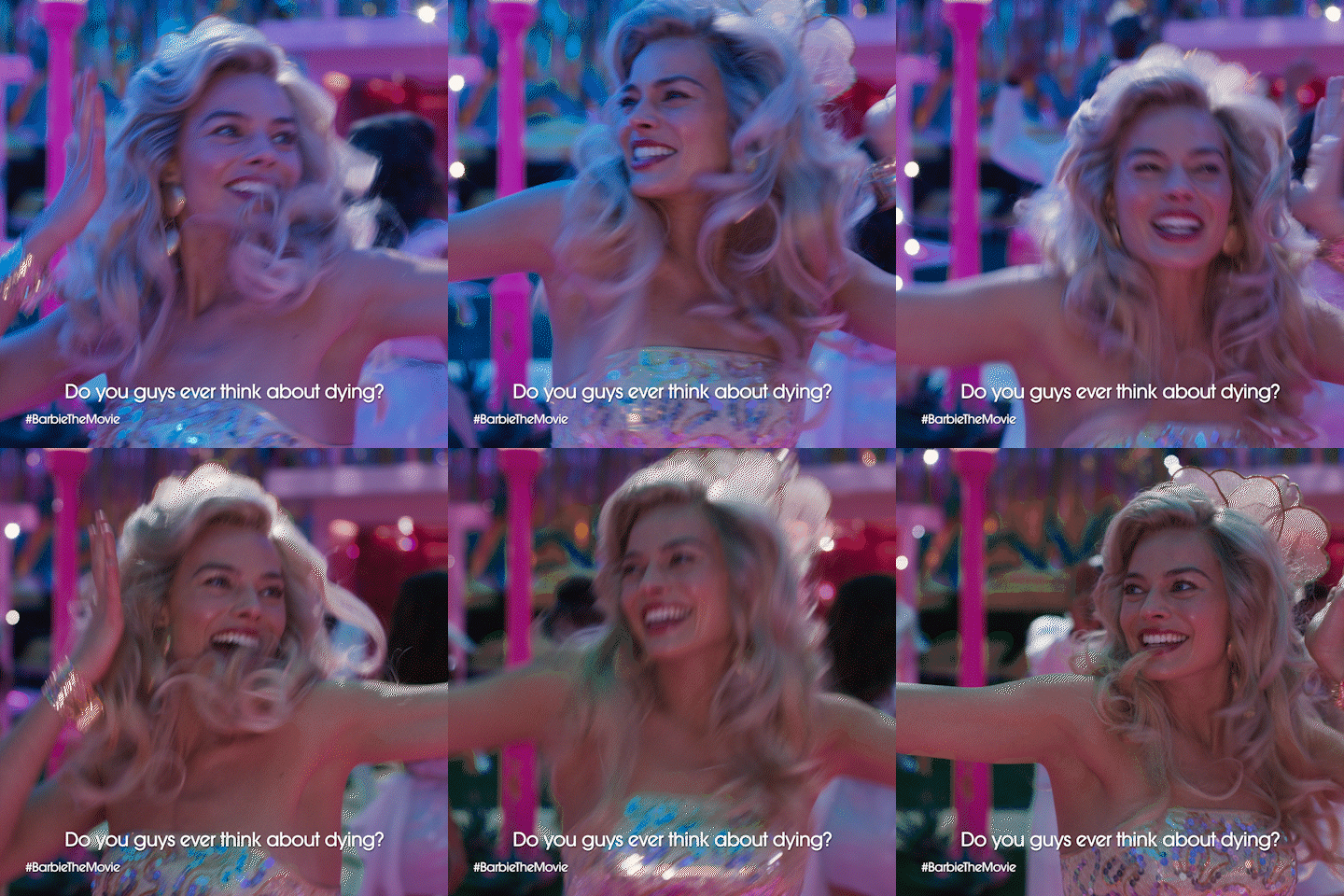
It’s also important to note that Ostlünd’s criticism steers clear of Barbie director Greta Gerwig, whom he refers to as an auteur, “One of the positives about capitalism is that as there is competition, we create more products. And we try to make them better than the last ones. And for that, we need word of mouth between audiences. But a film like ‘Barbie’ pirates this process by putting a ton of money into marketing, and there is barely any word of mouth.” Aside from what I see as the humor in the Triangle of Sadness director seeing any redemptive quality in capitalism, Ostlünd’s essentially describing the same process that Degen does in her Times article.
Now, Barbie obviously does have plot, theme, and character development. It’s undeniably part of what made it so successful. And it’s very easy to argue that the Marvel franchise supersedes any inherent cynicism in Barbie and Saltburn by glorifying patriarchy and the military industrial complex. Yet an overwhelming amount of criticism I’ve seen directed at all of these products is their lack of commitment to make inclusive, cohesive statements on the subjects they portray. This speaks much less to the intent of any particular artist, but to the system as a whole. Hollywood is an industry, and the decisions it makes don’t happen in a vacuum, though it might feel better to pretend that they do. Profit is profit, and on a balance sheet, the left side of the column becomes irrelevant.
Which brings us full circle back to Levinson’s latest controversy, The Idol. The Idol portrays pop star Jocelyn (Lily-Rose Depp) as she attempts to win back the admiration of her record label following a sex scandal. She soon encounters club-owner and cult leader Tedros (Abel Tesfaye A.K.A. The Weeknd), who seduces her with his schlubby rat-tailed charm, and becomes her de facto manager/producer/boyfriend/Dom. The Idol was originally supposed to be directed by Amy Seimetz, television auteur behind The Girlfriend Experience. 80% into the production of Season One of The Idol, Seimetz was fired following complaints from star Tesfaye that the series showed too much of a female perspective, according to sources speaking anonymously with Rolling Stone.
This cost HBO tens of millions of dollars and meant the rewrite and production restart of Season One from scratch. The report in Rolling Stone garnered attention upon its release in March of 2023, leading to another leak that Levinson laughed onset during a disturbing sex scene between Tesfaye and Depp, feeding Tesfaye lines such as, “I own you.” The scene was eventually cut, though much of The Idol includes exploitative portrayals of Lily-Rose Depp’s Jocelyn apparently consensual abuse at the hands of Tedros.

It’s important right here to draw the distinction between what Sam Levinson portrays and what filmmakers like Greta Gerwig and Emerald Fennell portray. Sam Levinson chooses to show young, blonde white women and girls suffering abuse at the hands of older, lecherous men. Gerwig might not be perfect at portraying the multi-faceted aspects of feminism, but that’s her intent. Fennell might not be perfect (or effective) at portraying class struggle, but that’s her intent. There is no similarity in intent between these artists. Their art, however, is made powerful by the same industrial process.
In the Rolling Stone piece on Levinson’s actions during the production of The Idol, a source revealed the palpable feelings surrounding Levinson’s power. “I got the vibe that the mood on set was, ‘What’s HBO gonna do, pull the plug? Yeah, right. If they want a third season of Euphoria, they’ll give me what I want…” Sam Levinson’s creations have been absorbed into the upper echelon of the hype machine, where consumers can engage with them from any variety of critical or appraising perspectives. The result is nonetheless the same: HBO makes money, Sam Levinson gets what he wants.
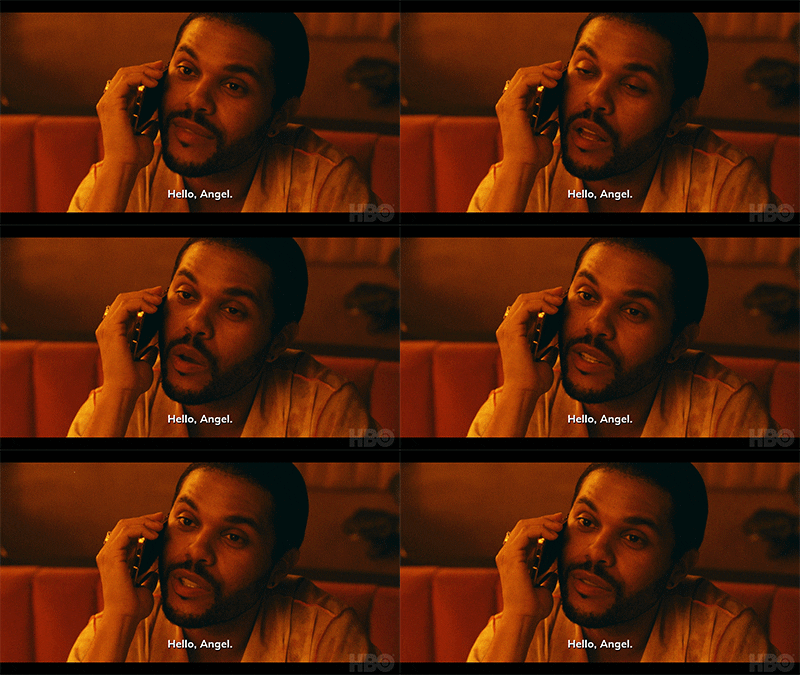
There is a cap on this power, though. Whereas Euphoria is no doubt offensive, it straddles the fine line of cultural acceptance in the hype machine by refusing to make any kind of coherent statement. We can hate Euphoria, but not worry that much about what its creator believes. The Idol was, if not a death blow to Levinson’s career, a warning that the unending revelation of his power fantasies actually do make a statement, thus breaking the social contract of hype machine media. Whether Euphoria returns for a third season or not, Levinson might have been finally forced to contend with the fact that his cultural blank check, the same one given to him at birth and propagated by a media world that favors vibes over substance, has the possibility of bouncing.
In the post-episode “making of” mini-documentary following the finale episode of The Idol (which I unfortunately watched), the final moments of production are shown in a deliciously awkward clip. Levinson, surrounded by a crew of masked, black-shirted anons on one side and a glammed-up Lily-Rose Depp on another, stands atop a tiny platform. Levinson limply shrugs and, with the charisma of Bob Dole, sheepishly proclaims, “That’s a wrap.” The crowd erupt in applause as Levinson descends the platform, seemingly unsure of the worth of what he’s made this sycophantic battalion produce. The Idol might have been one of the most egregious shows in television history, but damn, what a tragic ending.
What do you think of the Sam Levinson controversy? Do you think Euphoria will come back for Season Three? Leave a comment below!


Leave a Reply