

This article was written by The Zillennial Zine’s spring editorial intern Henry Ryeder. Find him on Instagram at @henryryeder. If you would like to share an article with The Zillennial, send us an email at thezillennialzine@gmail.com.
In one of the more egregiously offensive moments in Max’s Girls on the Bus, political reporter Sadie McCarthy (played by a dedicated Melissa Benoist) is caught in a bind. Railroaded by the Democratic frontrunner’s press secretary (who happens to be her ex) outside the candidate’s hotel room, Sadie has to get creative. Seeing a member of the cleaning staff to her left, she launches into a spirited appeal. If she’s not let into candidate Caroline Bennett’s room, Sadie explains, she’ll lose her job. And to whom will Sadie’s job go? A man will take it “right out from under us.”
The supposition that Sadie, and by proxy the show, are trying to establish is clear. Sadie’s struggle is the Housekeeper’s struggle (actor Oksana Galyuk is only credited as such at the episode’s end.) Sadie’s employed at a Times analogue, the New York “Sentinel,” secure in a cozy, high-paying job, benefiting from all sorts of systemic privilege, and whose friend previously joked about the amount of free wings Sadie was able to eat at an insider political event for the press. The Housekeeper is employed in a position that’s dubiously keeping her above the poverty line. Yet according to Sadie and the show, both of these women are in the same campaign against the patriarchy.
Sadie continues in her rant about the commonality of their battle. They just get to win, even though Nate Silver promised us they wouldn’t! This was very cringe-inducing to watch, and I expected the show to have the self-awareness to make the Housekeeper brush off Sadie’s request. After all, this would be a funny and introspective moment for Sadie, a “Gonzo” (according to her) style journalist who often lets her feelings impact her perception of the truth. Yet in one of the most epically painful moments in scripted television I’ve seen in a while, the Housekeeper (whose grasp on English has thus far been kept in question for “comic” effect), tells Sadie in an ethnically ambiguous accent, “Fuck Nate Silver.” The Housekeeper, stuck in a dead-end low-wage job, inhabits the same political and media spheres as Sadie. Their quest for equity is one and the same…though it’s Sadie who obviously gets to be the face and beneficiary of that quest. While they may come from different backgrounds, and perhaps even hold different political beliefs, they’re still Americans! And can’t we find the beauty in that?
This is The Girls on the Bus in a nutshell. Adapted from Amy Chozick’s memoir of her time following Hillary Clinton’s campaign in 2016 and executive produced by television impresario Greg Berlanti, The Girls on the Bus is nothing if not good television. A slick, glossy, carefree portrait of aspirational characters at the top of their games, The Girls on the Bus had me yearning for a spot on the bus from the pilot through the latest, Episode 3: The Audacity of Nope. Yet I wouldn’t be offering a Girls on the Bus review if this were all the show represented. At its core, The Girls on the Bus’s greatest strength is its greatest flaw: it’s damn good propaganda.
If I were closer to its target age demographic, or more contently employed and compensated under capitalism, I’d perhaps write off The Girls on the Bus as a silly advertisement for an America that doesn’t exist. Lucky for you, dear reader, I’m neither of those things, and I don’t think that Amy Chozick, co-creator Julie Plec, and Greg Berlanti’s fantasy about the role of media in American politics is anywhere close to acceptable in today’s cultural climate. At the very least, it’s ripe for examination.
The Audacity of Max
The first episode of The Girls on the Bus plays as follows. Sadie McCarthy is an intrepid political reporter at the New York Sentinel still reeling from her notoriously rosy coverage of presidential favorite Felicity Walker that culminated in Walker’s upset defeat (think Trump/Hillary.) Now in the middle of another campaign season, Sadie gets a big break when her boss Bruce lets her follow Democratic frontrunner Caroline Bennett on her campaign bus trail through the primary. Bruce, as it seems, always has the time to talk Felicity through each and every issue she encounters with great detail, smoking in his office with apparently no other work to do (which, the more I think of it, is probably pretty realistic.)
At the campaign’s first stop in Iowa, Sadie meets up with her old friend Grace Gordon Greene (Carla Gugino, reliably in good television form), a political reporting stalwart whose family connections aid her in getting scoops. While Grace’s plot in the pilot mostly revolves around her navigation of work-life balance with her college-aged daughter, the episode really shows its finger’s on the pulse with its two other series regulars. These are Lola (Natasha Behnam), a Gen Z influencer intent on taking down legacy media, and Kimberlyn Kendrick (Christina Elmore), a television personality for Fox analogue Liberty Direct News whose identity as a Black woman is sometimes at odds with her corporate overlords.
After Lola saves Kimberlyn from a gang of violent college activists (oh trust me, more on that below), the two become stranded on an Iowa side-road. Ever plugged in, Sadie’s able to leverage this, extracting from Kimberlyn the room number of Caroline Bennett (who’s booked her first interview with Kimberlyn) in exchange for Sadie getting Kimberlyn a ride back to town. Sadie shows up at the room, and, as mentioned before, Caroline’s press secretary is Sadie’s beau from a simpler time. Needless to say, Malcolm (played by Brandon Scott and charmingly nicknamed “Loafers”), isn’t about to let Sadie in. Sadie’s able to use her Nate Silver speech to the Housekeeper to open Bennett’s room one last time, allowing Sadie to have a truly hard-hitting interview with Bennett, buttoned with the thought-provoking, “How are you going to break our hearts?” Sadie’s interview is about to publish when a major story breaks about Bennett’s involvement in a sex scandal, a bizarre rabbit-hole concerning fruit that’s slowly eked out over the course of several episodes as…some kind of whimsical abuse ring?
Chasing Chozick
I’m chuckling to myself trying to justify how the above description makes for good television. The simplest explanation is that series creator Amy Chozick is terrific at her job. What her job actually entails is where we’d probably disagree. Chozick has had quite the successful career in journalism. Starting at the Wall Street Journal in its post-9/11 official mayhem, Chozick began writing about Hillary Clinton during her unsuccessful Democratic Primary campaign in 2008. Chozick then joined the Times in 2011, going on to conduct political reporting that culminated in Chozick’s coverage of Hillary’s campaign in 2016. Chozick’s book on that experience, Chasing Hillary: Ten Years, Two Presidents, and One Intact Glass Ceiling, became a New York Times bestseller.
Between the book’s release and the release of its small-screen adaptation, Chozick’s done a lot of reporting for the The Times. While Chozick’s prosaic abilities aren’t in question, a cursory glance at her reportage reveals a glaring, recurring theme.
From October 10, 2019: “This C.I.A. Officer Wants to Give Peace a Chance: Amaryllis Fox opens up about espionage, government-issued sex, and coming-of-age in her new memoir, ‘Life Undercover.’”
From December 27, 2019: “The Rikers Coffee Academy: Can teaching inmates to make lattes give them a chance at a better future?”
From January 17, 2020: “This is the Guy Who’s Taking Away the Likes: Adam Mosseri, chieftain of Instagram, wants to keep the platform a safe, special place.”
In Chozick’s reportage, the machinations of the American political, military, and economic complexes are working largely as they should. Sure, there’s some bad actors and people who make mistakes, but these are people, after all!
This romanticization of the American political and economic elite is just as clear in Sadie McCarthy’s love of Caroline Bennett as it is in Chozick’s piece on Theranos founder Elizabeth Holmes. In her 2023 article “Liz Holmes want you to forget about Elizabeth,” Chozick goes to extreme lengths to sanitize Holmes’s well-documented cover-up of her own faulty immunoassay-conducting “Edison” machines. Interviewing Holmes and her family over the course of several days, Chozick gives an impression of a strong, albeit wronged female professional who’s finally come into her own after an abusive relationship with her former business and romantic partner Ramesh “Sunny” Balwani. Balwani may very well have been abusive, and Holmes may very well have felt trapped. But the idea that Holmes, the daughter of a former Enron V.P. whose upward trajectory as billionaire C.E.O. exploded with conscious efforts to stifle regulatory and safety practices, had no power whatsoever is absurd. It’s also a classic Chozick bourgeois fairytale. Let’s parse out some of Chozick’s language in the piece.
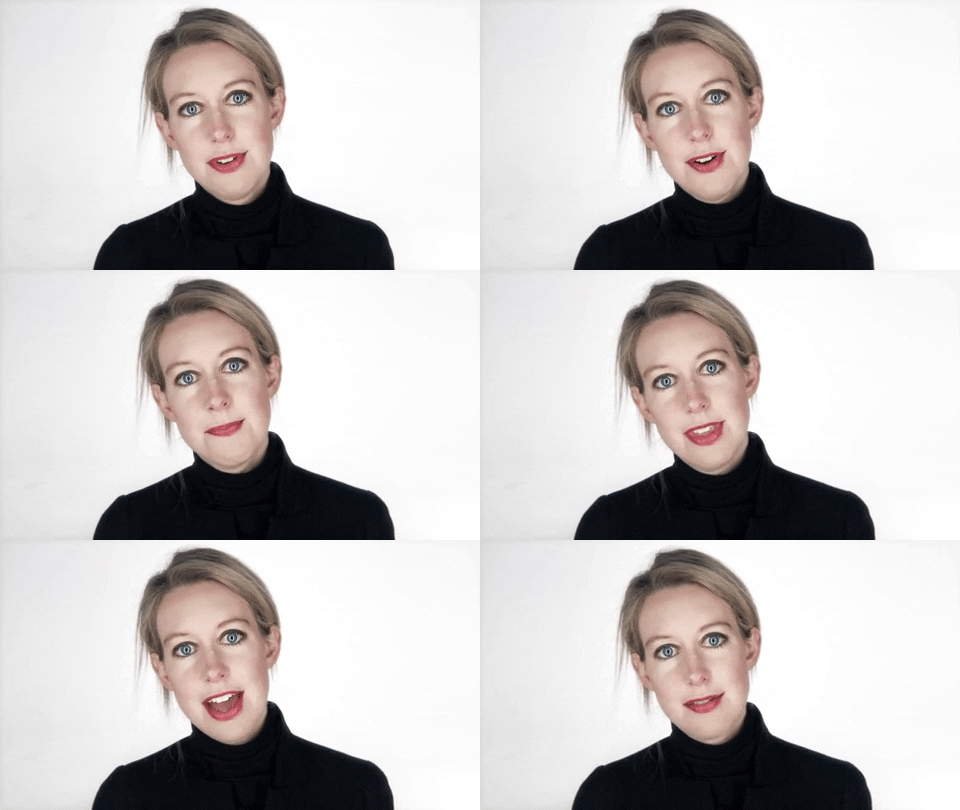
“Ms. Holmes was not convicted on any counts related to patients. But the testimony was a stark reminder of the human stakes of choosing biotech as your start-up.”
Translation: Ms. Holmes is most likely innocent, and being a billionaire professional is scary! Have sympathy!
“A Daily Mail headline referred to the baby as a ‘Last-Ditch Bid for New Trial.’ But, as Ms. Holmes explains it, it’s just bad timing (to put it mildly). She is 39. She fell in love with Mr. Evans in 2017. They did not anticipate that she would be indicted.”
Translation: The media’s been so unfair to Ms. Holmes. She and her picture-perfect family never believed that someone who’d defrauded tens of thousands of sick patients and several billionaire investors would face serious consequences.
“One of the last times we spoke, I asked Ms. Holmes to clarify what she meant. As C.E.O., wasn’t she in charge? She said Mr. Balwani did not control her every interaction or statement at Theranos, but she ‘deferred to him in the areas he oversaw because I believed he knew better than I did,’ and those areas included the problematic clinical lab.”
Translation: Liz Holmes is the victim, not the perpetrator of the crimes she very obviously, publicly, and verifiably committed.
This last contention encapsulates the tricky nature of a lot of Chozick’s work in journalism and in The Girls on the Bus. It’s not fair to say that any woman in the United States isn’t victim to the vast array of systemic and cultural oppressions that are woven into its social fabric. Add to this the pressure of being a woman of power in this society, and the misogyny is broadcast on a macrocosmic scale. If Chozick were only interested in this aspect of what it means to be a woman of power in the United States, her work might ring a bit more true. Yet Chozick’s efforts, whether committed consciously or not, exculpate the malicious actions of powerful people under the guise of feminism. The resulting work is so jarringly counterfactual that it seems simply otherworldly. This defines the propagandistic fantasy world of The Girls on the Bus.
“Hunter S. Thompson didn’t just write what he saw. He wrote how he felt. He found a deeper truth.” – Sadie McCarthy
In a recent interview promoting The Girls on the Bus, Chozick explained her desire for the audience’s takeaway. “These girls…are giving their life to the job, and all they want is to find the truth. That’s actually what journalists do.” I’ve outlined how Chozick’s work services the political establishment in opposition to the truth, but Chozick’s explanation takes it a step further. In her view, it’s the job of all American journalists to find the truth. That would be nice if most high-brow media publications, such as the ones referenced in The Girls on the Bus, didn’t actively launder ultra-conservative ideology through the lens of liberal intellectualism.
“Several reliable, well-informed sources confirmed the idea that Hitler’s anti-Semitism was not so genuine or violent as it sounded, and that he was merely using anti-Semitic propaganda as a bait.”
– Radical, fringe publication? Nope, the New York Times, November 21, 1922.
“One sees ‘comparatively few markerd [sic] Semitic types: and fewer still of the East Side, bearded, skullcapped, moth-eaten, grease-spotted, parchment-dry rabbis.”
– Fox News description of a synagogue? Nope, the Atlantic’s description of Tel Aviv, October 1949.
“Red PT Boats Fire at U.S. Destroyer on Vietnam Duty.”
– J. Edger Hoover’s diary? Nope, the New York Times, August 3, 1964, publishing misinformation (the destroyer in question actually instigated the firefight against the “Red” PT boats) concerning incidents in the Gulf of Tonkin. This alleged attack would lead President Lyndon Johnson and Congress to pass a joint resolution allowing America’s conflict in Vietnam to begin in earnest.
“U.S. Says Hussein Intensifies Quest For A-Bomb Parts.”
– Bush-era propaganda? Correct! This is from a piece written by Michael R. Gordon and Judith Miller in the New York Times, September 8, 2002. The story sourced this unverified claim from C.I.A. officer Valerie Plame. Miller and other Times reporters’ coverage of the prelude to the invasion of Iraq was so overtly jingoistic that the Times was eventually forced to publish a lengthy apology. This essentially served as an admission that its coverage, craftily utilized by the Bush Administration to sway public opinion, was based on hearsay, speculation, and unverified sources. This mea culpa was published on May 26, 2004. By this point, at least 600 American military personnel, as well as over 18,000 Iraqis (civilians and combatants) had been killed in the conflict.
“Mr. Davidi, who produces chicken eggs…received a threatening WhatsApp message reminding him in Hebrew that his chicken coops had already been hit twice. ‘We won’t miss the target a third time,’ the message read. It was signed Hezbollah. The New York Times, which viewed the message, could not independently confirm its origin.”
– This recent story, concerning northern Israelis’ anxieties around Lebanese military assaults, portrays a community in a fight for survival. Pushed to the brink by the horrors of war, these people heroically stand their ground in the face of terror attacks. The hypocrisy in covering the anxieties of Israelis while an ethnic cleansing is being carried out next door is underscored by Times’s citation of Davidi’s Whatsapp message. “Signed Hezbollah…The New York Times…could not independently confirm its origin.” Good thing the paper of record included this tantalizing bit of information, especially considering its continued refusal to vigorously report on the over 30,000 deaths in Gaza.
We didn’t do it, Joe
Obviously, the deployment of American legacy media to service the whims of America’s political elite isn’t entirely the fault of people like Amy Chozick. Still, it’s important to interrogate some of the implicit claims that people like Chozick make in their work.
In an undeniably entertaining scene in Episode 3 of The Girls on the Bus, candidate Felicity Walker gets into a heated exchange with a misogynist chef in a restaurant’s kitchen. Bra-burning feminists like Walker, the working-class Joe argues, are ruining the country. In a moment of tactical genius, Walker removes her bra and burns it on the stove, soliciting both applause and a shower from the sprinklers. Lola, who up until this moment has been shamelessly “promoting the socialist candidate,” simply Instagram Live’s the unfolding scene in raptured awe.
Walker’s clearly a stand-in for Hillary Clinton, and Chozick displays a clear knack for manifesting an aspirational, unfettered version of Hillary for entertainment. But what about Walker makes her a decent candidate beyond her gender? This is where The Girls on the Bus really shows, or rather obfuscates, its underpinning message. In Chozick’s world, policy is an afterthought. The only substantive mention of policy comes earlier in Episode 3, in which Sadie, listening to a “boring” speech on labor unions by a candidate played by Scott Foley, instead imagines him stripteasing her. What really matters, the show implies, is how the candidates present. This is also underscored by Sadie’s first voiceover in Episode 1, in which she claims, “With politics having descended into one endless horrific reality show, isn’t the Presidential Primary just a higher-stakes version of The Bachelor?” Sadie goes on to give a description of the candidates’ vibes, detailing how they may or may not win based on their levels of attractiveness, attitudes, and hobbies.
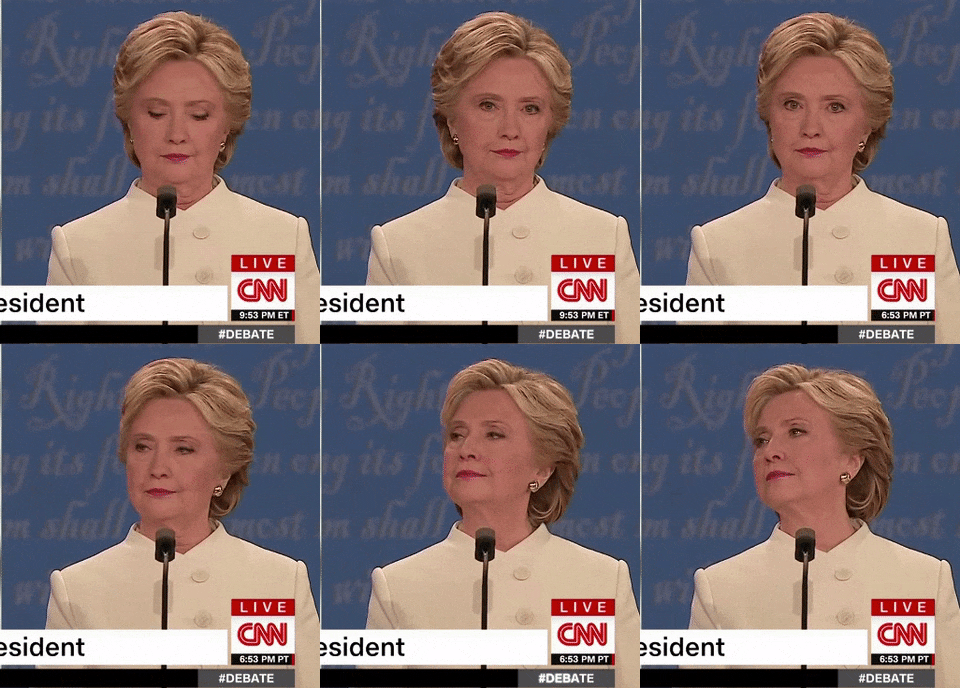
Politicians, even ones who make history, aren’t just nominal action figures who represent the United States on screens. They have considerable power and influence, and more often than not, exert that influence to deadly degrees. Let’s take Hillary Clinton, for example. In her great piece from 2016, “Hillary Clinton: Secretary of War,” Elizabeth Schulte details how Clinton exercised her offices as U.S. Senator and Secretary of State in the Obama Administration to expand American power overseas. This included voting for the Invasion of Iraq as a member of Congress and later (under Obama) ordering drone strikes in Somalia, Yemen, and Pakistan that killed at least 380 civilians. The drone strikes were facilitated through an agreement with the C.I.A., in which that agency would request Clinton’s State Department for official approval. Clinton could approve these strikes from her cellphone, she did so in all but one or two instances of request.
Clinton’s vision of America’s role in the world didn’t stop there. Aside from securing defense contracts for weapons manufacturers such as Lockheed Martin, Clinton made her understanding of “economic statecraft” expressly clear in a 2011 foreign policy speech, “We have to position ourselves to lead in a world where security is shaped in boardrooms and on trading floors as well as on battlefields.” Clinton’s understanding of American foreign policy is also commensurate with neoconservative understandings of Israel as a “bulwark against barbarism” in the Middle East. Clinton herself wrote on campaign stationery in 2015 that she would “fight back against further attempts to isolate and delegitimize Israel.” As for Israel’s 2014 bombing of a United Nations school and refugee camp in Gaza, Clinton contended, “We’ve made [mistakes]. I don’t know a nation, no matter what its values are — and I think that democratic nations have demonstrably better values in a conflict position — that hasn’t made errors.”
Hillary Clinton, of course, is not the only prominent woman in American politics who facilitates acts of state-sanctioned terror. As California’s Attorney General, future Vice President Kamala Harris appealed a federal judge’s 2014 ruling that found capital punishment unconstitutional. Harris would also gain a reputation for her record on wrongful conviction cases, stone-walling attempts by defendants to obtain further evidence in appellate courts. As District Attorney for Hennepin County in Minnesota, future Senator Amy Klobuchar successfully prosecuted 16-year-old Myon Burrell for the shooting of an 11-year-old girl, a case later revealed to have serious flaws. According to the Associated Press, “There was no gun, fingerprints, or DNA. Alibis were never seriously pursued. Key evidence has gone missing or was never obtained, including a convenience store surveillance tape that Burrell and others say would have cleared him.” Klobuchar would continue to cite the Burrell case as an example of her “tough-on-crime” approach throughout her 2020 Democratic Primary bid.
Alice Cappelle, in her great video essay, “How Liberal Feminism Turns into Fascism,” details the fundamental flaws in romanticizing essentialist assumptions of “womanhood” while forsaking intersectionality. Cappelle cites Simone De Beauvoir, who posited that one is not born a woman; rather a woman is created, becoming submissive through education. Cappelle makes this point in reference to some women in French politics and media: in seeking to glorify “feminine values,” they glorify submission and seek to impose it on others. This is in opposition to protests and uprisings among the oppressed that might necessitate some form of violence.
I quite obviously don’t have the lived experience to dissect the crossroads of liberal feminism and state-sponsored terror in America. However, I do think it’s interesting that, similar to Cappelle’s point, Chozick’s work belies a political view based on values of behavior rather than substantive, actionable measures.
Cancelled Culture
In the juiciest, most ridiculous moment in The Girls on the Bus, conservative television personality Kimberlyn confronts “socialist” candidate Althea Abdi outside of a college campus lecture hall. “Do you really believe that redistribution will benefit the poor when capitalism has lifted more people out of poverty than any other economic system? Why are you afraid of Liberty Direct News!?” As Abdi slinks away from these mind-bending questions, a White, male student in a beanie gets up in Kimberlyn face. “Maybe it’s because you’re the devil!” A trite exchange that reads like a Gail Collins/Bret Stephens column ensues, climaxing as a White female student throws a latte at Kimberlyn’s jacket. Lola, thus far capturing the incident for Instagram Live (because we all know how much Gen Z loves their Instagram Live), has a moral awakening and rushes to Kimberlyn’s aid. Later, when trying to justify her act of heroism to her more barbaric Gen Z friend, Lola explains, “She was being attacked, Ashley. Violence against women isn’t a partisan issue.”
The “unruliness” of young, progressive college students is a conventional piety in American politics. Nixon weaponized this idea to defend his Vietnam position, “Sometimes they, as you know, talk so loudly that it is difficult to be heard.” A recent ad for a podcast entitled, “Unpacking Israeli History” claims there’s a lot of “loud” talk about genocide. In 2022, writer Adam Johnson compared coverage of a record heatwave that endangered the lives of the incarcerated in Texas with coverage of “cancel culture” on college campuses. Johnson found that in a three-month period, not a single major news publication dedicated a word to the inhumane prison conditions, while the Times, Washington Post, and Wall Street Journal cumulatively published 28 pieces on free speech fights in the media and academia.
The Girls on the Bus‘s campus protest scene serves a similar end. The sequence illustrates an ideological division that’s then sewn up through the shared value of protecting women against latte-wielding college kids (if you hadn’t already surmised, Chozick also wrote about being harassed by Bernie Bros during the 2016 campaign.) It would be a great scene if it weren’t a complete fantasy. Activists on college campuses extend across racial and gender divides (as did Sanders supporters in 2016), and while it’s never hard to find an ass of a white guy (we’re pretty common, if the last 8,000 years haven’t given you the tell), activism is clearly not relegated to one identity. After all, most mass-protests on American college campuses in the last couple of years have concerned women’s bodily autonomy and curtailing the ethnic cleansing in Palestine, both issues that serve far more than the pilot episode’s bogeyman Bernie Bro.
Yet this is exactly what The Girls on the Bus aims to do. In establishing an Overton Window of American political divide, the show presents ultra-conservatism as being the “antidote” to a violent, unruly Progressive Left. In the fight for survival against the Woke Mob, Lola and Kimberlyn are able to bond. There’s an ideological divide that, while vast, can be remedied by good old compromise.
Chozick, the New York Times, and a Self-Serving Overton Window
The Overton Window is a conceptual product of a libertarian think-tank, courtesy of Joseph Overton. The term can be best understood to mean the range of acceptable political beliefs at a given time and place. For example, “leftist” vs. “right-wing” understandings of the ethics of American slavery understandably differ now from what they entailed at the onset of the Civil War in 1861. Yet, in the context of colonialism, these political identifications can become awfully trivial.
This is exemplified by the eternal debate between American “liberals” and “conservatives.” While “Liberals” largely adhere to some loosely regulated free-market economy that promotes egalitarianism, this is far to the Right of what could be described as the Political Left. Leftists would more readily argue for a more socialized welfare state in which systemic failings are remedied through direct government control, not successive waves of election that simply maintain the status quo. In this reading, there’s nothing particularly “left-wing” about liberalism, though that’s the derogatory term associated with legacy media to describe its progressive leanings. Consider liberals’ faith that a small government, free-market economy can promote equality. The system that American liberalism has produced since the 1980’s, Neo-liberalism, can thus be seen as a “tasteful“ form of the capitalism that Marx defined in his teleological understanding of history. Brutal, oppressive, and colonial, but polite.
This is why it’s difficult to describe “conservatism” in the United States. The vast majority of American politics on both “sides of the aisle” display inordinate loyalty to an ultra-conservative status quo. America is the greatest nation on earth. Abraham Lincoln ended slavery. The Founding Fathers were geniuses. Any of these sound familiar? They’re such commonplace American adages that they’re not even slightly questioned in politics or the vast majority of American media. Sure, throw in an occasional mention of the New Deal, but make sure to footnote that World War II manufacturing was what really ended the Great Depression. Even Jeff Daniels’s viral (if nauseating) opening monologue in Aaron Sorkin’s The Newsroom caveats his explanation that the United States is not the greatest nation in the world with, “We sure used to be.” Ultra-conservatism is viewed as the norm.
These political categorizations should be understood through an uncensored lens of American history. As a settler colony that effectively massacred its indigenous population and grew to become the most powerful empire on the planet, political quibbles between the upwardly mobile, largely White Americans who dominate political discussion can (quite justifiably) seem nonsensical. Yet it’s imperative to understand how American ultra-conservatism and liberalism benefit each other in the fabricated tug-of-war of American politics.
Let’s take a hut-button issue such as the COVID-19 vaccine distribution for example. The New York Times Morning Newsletter, filed neatly into the email inboxes of 17 million readers (mine included) devoted mammoth coverage to vaccine rollout and politics in 2021 and 2022. Spearheaded by David Leonhardt, the Morning Newsletter published a series of articles extolling the effectiveness of the vaccines very early on “Covid on the run in the U.S.” However, as the reality of Covid outbreaks became clear, Leonhardt used his bullhorn to systematically implore a full public reopening without restrictions such as mask mandates.
To be clear, not all of Leonhardt’s rhetoric about Covid was fallacious and misleading. But Leonhardt was a political reporter before he was a self-appointed Covid authority. And it’s passages like this one, from a recent Newsletter on the fourth anniversary of lockdowns, that show Leonhardt’s skill and intentions, “While many liberals exaggerated the value of pandemic restrictions, they were right about the vaccines. After vaccines became available, a huge partisan gap in Covid deaths opened.”
Leonhardt’s aim here is clear: present the pandemic as a series of political divisions between two diametrically opposed factions in the United States. That’s a truism, of course. As many an establishment wonk will complain, we’re so polarized! And in a politically divisive atmosphere, both sides can own up to being wrong, can’t they? Leonhardt’s deft construction of an Overton window between anti-vax conservatives and mask-touting liberals serves the same, conservative, neo-liberal purpose: take a shot and get back to work.
Conservatives might disagree that “taking a shot” is a conservative or libertarian position. But it’s important to recognize that Leonhardt doesn’t seem particularly vexed about conservatives’ reluctance to take vaccines. That’s just a given in American politics. In his mind, it’s the “Left” that must wake up to their own faulty risk assessment and logic, and that in order to bridge this presumptive ideological divide, they must acknowledge that there are, if not good people, at least Americans on both sides.
The fundamental question here is, who benefits from this manufactured fomentation of political discord? Conservatives would argue that it’s the Left who are enrolled in Ivy League universities (who themselves are only Marxist for about a semester before they intern at Goldman Sachs, as Intercept correspondent Jon Schwarz painfully joked recently.) In this understanding, legacy media only offers controlled opposition that ultimately serves progressives. If not for the Times, the United States would be able to cut taxes for the wealthy, detain tens of thousands of women and children at the Southern border, approve massive oil drilling projects, allow unfettered access to assault rifles, stack the courts so that abortion protections are overturned nationwide, aid and abet Israel’s genocide in Gaza without obstruction, and you know…everything that’s already happening.
My only response to self-identified conservatives and libertarians who truly believe that the system is working against them is: you’re correct. However, it might be helpful to ask some tough questions, “Is Donald Trump really a political outsider when his tax cuts directly benefit the Bezos and Zuckerburg elites I abhor?” “How do I reconcile distrust in big government while adhering to a looming 15-week national abortion ban?” “How protectionist can my views on immigration be when I’m opposed to serious efforts to codify workers’ rights?”
Bulwark Against the Bus
My questions for people like Amy Chozick are more complicated. For one, I think most self-identified, college-educated liberals really do want to believe that their work and political lives aid a greater sense of American egalitarianism. Therefore, my response to Amy’s rose-colored political lens would be a request that she take a closer look at the language she uses.
In the first episode of The Girls on the Bus, Sadie’s boss Bruce tells her, “the Media are under attack. We cannot show even a hint of bias.” The implication here is that the Times goes to great lengths to appear politically impartial. I agree that, when economically expedient, the Times does a lot of great coverage, as do many legacy publications. Yet whatever sweet-hearted, sincere actors there may be in publications such as the Times, the effect that it has on American politics is the same. Biden reads the Times Newsletter and has privately agreed with much of its Covid coverage. While the manufacturing of political discord among factions of settler colonists isn’t solely the fault of publications such as the New York Times or shows like The Girls on the Bus, their glorification of this system only serves the American political establishment.
I can appreciate The Girls on the Bus as an appropriative piece of conservative propaganda. I can also appreciate Amy Chozick as a deft writer. I feel comfortable doing these things because I have a strong sense of my own political beliefs and hold a confident level of media literacy. Yet, despite what the Housekeeper’s character might have you believe, people like me are the exception to the norm. Programs like The Girls on the Bus need to be called out for their jingoistic conflations of feminism and American exceptionalism. Not only is it wrong, influentially malevolent, and frustrating, it’s just out of touch.
Upon rewatching the college campus scene, I was amused to see a prop campaign poster for the “socialist” candidate. Above the announcement of guest speaker “Althea Abdi,” a tagline reads, “The revolution will not be monetized.” For once, Amy Chozick is right. It won’t.
What do you think of The Girls on the Bus? Leave a comment below!


Leave a Reply