

This article was written by The Zillennial Zine’s spring editorial intern Henry Ryeder. Find him on Instagram at @henryryeder. If you would like to share an article with The Zillennial, send us an email at thezillennialzine@gmail.com.
I still remember the palpable rage of March 27, 2011. It was Oscars Sunday, and like all Oscars Sundays, I couldn’t stay up too late, lest I risk exhaustion during the long trek to school on Monday morning. Yet my fury on this particular evening didn’t stem from anything physical; rather it came from a purely principled stance. I had spent the previous six months enamored with Hans Zimmer’s score for Inception.
Upon thinking of the music of that film, most readers will probably skip to the infamous “BUAM BOM“, the slowed and skewered sample of Edith Piaf’s “Non, je ne regrette rien” that became synonymous with Inception‘s heavy-handedly cerebral design. Yet it was “Time” off this soundtrack with which I became enamored. The four-and-a-half minute opus toward the end of the film includes only four chords, yet builds upon hundreds of layers to climax and collapse in one of the most beautiful moments in film score history.

Zimmer didn’t win. That prize would go to Trent Reznor and Atticus Ross for The Social Network. Needless to say, as a film nerd, I was very familiar with the score for that film as well. Several of the main themes were on my iPod Nano (which I also used to watch The Social Network and Inception on long bus rides). I loved the simple musical themes supplemented by Reznor’s and Ross’s foreboding synths and arpeggiators. I loved the electric guitar tones. Yet it was so simple. Compare that to Zimmer’s masterpiece; did Reznor and Ross really deserve the win?
Playing and Scoring
The question of minimalist genius vs. monotony has trailed Reznor and Ross’s film scoring in a way that’s never haunted Reznor’s prodigious industrial project Nine Inch Nails (Ross officially became a member of NIN in 2016). That trailblazing enterprise, for decades spearheaded solely by Reznor, married abrasive hard rock and electronic production to crossover aplomb. Nine Inch Nails’ second full-length album The Downward Spiral put Reznor on the map as an alt-pop star on par with David Bowie (who himself would recruit Reznor for collaborations throughout the 1990’s). Perhaps not so coincidentally, the opening seconds of “Mr. Self-Destruct” off that record includes an artifact-heavy sample of a tennis match…
Reznor and producer Atticus Ross began working together in 2002 for Reznor’s side project Tapeworm. In 2010, Reznor joined Ross’s already burgeoning scoring career, first collaborating on the score for David Fincher’s The Social Network. That score wouldn’t only nab the pair an Academy Award, it would become one of the most undeniably influential scores of the next decade, an impressive feat in a contemporary period that yielded Daft Punk’s Techno-Bach score for Tron: Legacy, as well as Zimmer’s peak work on Christopher Nolan’s Inception and Interstellar.
Musically, Reznor and Ross’s Social Network score encompassed aspects of its moment that also predicted the soundtrack music of the next ten years. The bubbling bass pulses and arpeggios of “In Motion” feel as indebted to Mason and Princess Superstar’s 2007 song “Perfect” as much as it clearly influences the Stranger Things score. The extraterrestrial processed guitars on “Intriguing Possibilities” punctuate Aaron Sorkin’s courtroom dialogue like cinnamon on a tart; a testy element that belies something slyly challenging about the whole affair.
Reznor and Ross have recorded several scores since then, ginning up praise and awards for their soundtracks to The Girl With The Dragon Tattoo, Gone Girl, Soul, and Mank. One of these recent collaborations was for Luca Guadagnino’s Bones and All.
Object and Subject
Guadagnino for, better and for worse, is the Adrian Lyne of our time. Sitting at a careful crossroads between the superficially-curated politics of Post-#MeToo and a corporate veneer of inclusive hedonism, Guadagnino’s proven to be one of Hollywood’s most powerful instruments. Cranking out Gen Z’s defining (if already dated) erotic romance Call Me By Your Name, Guadagnino pushed forward with his heady take on Dario Argento’s Suspiria in 2018. I personally find the original Suspiria much sexier, smarter, and scarier, but hey, Thom Yorke’s score was pretty good.
In all of Guadagnino’s films, the director seems to mimic 1980’s erotic maestro Adrian Lyne’s sentiment that “movies are sex” better than any overpaid crackpot working in film today. I’m writing this the night after watching The Idea of You, the “erotic” dramedy about an “older” woman dating a famous 24-year-old pop star. Good Lord, I saw more sexual chemistry between Anne Hathaway and her rehab clinician in Rachel Getting Married than I saw between she and Nicholas Galitzine.
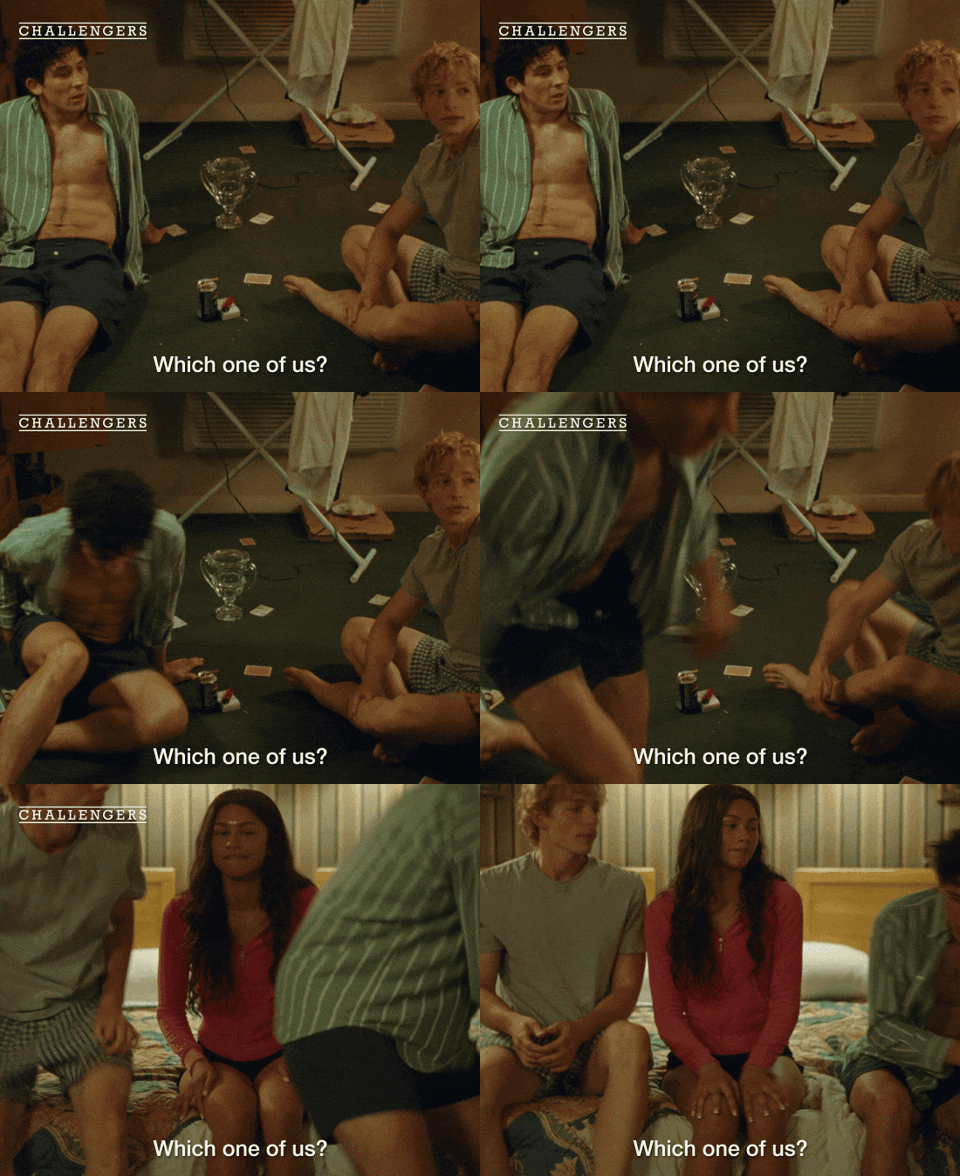
One of the reasons that Guadagnino is so effective at eroticizing seemingly “sexless” things (a peach, a finger, a tennis ball) is his effortless command of rhythm. Studio executives love editing cuts because, as the conventional wisdom goes, kids these days just don’t got attention spans like they used to (which is why they flock to headache-inducing action comedy flicks like Argylle, such a winning formula). Consequently, those same executives also love coverage (multiple angles of the same action) to use as collateral in the event that they want more editing, shorter scenes, and less vision getting in the way of the product.
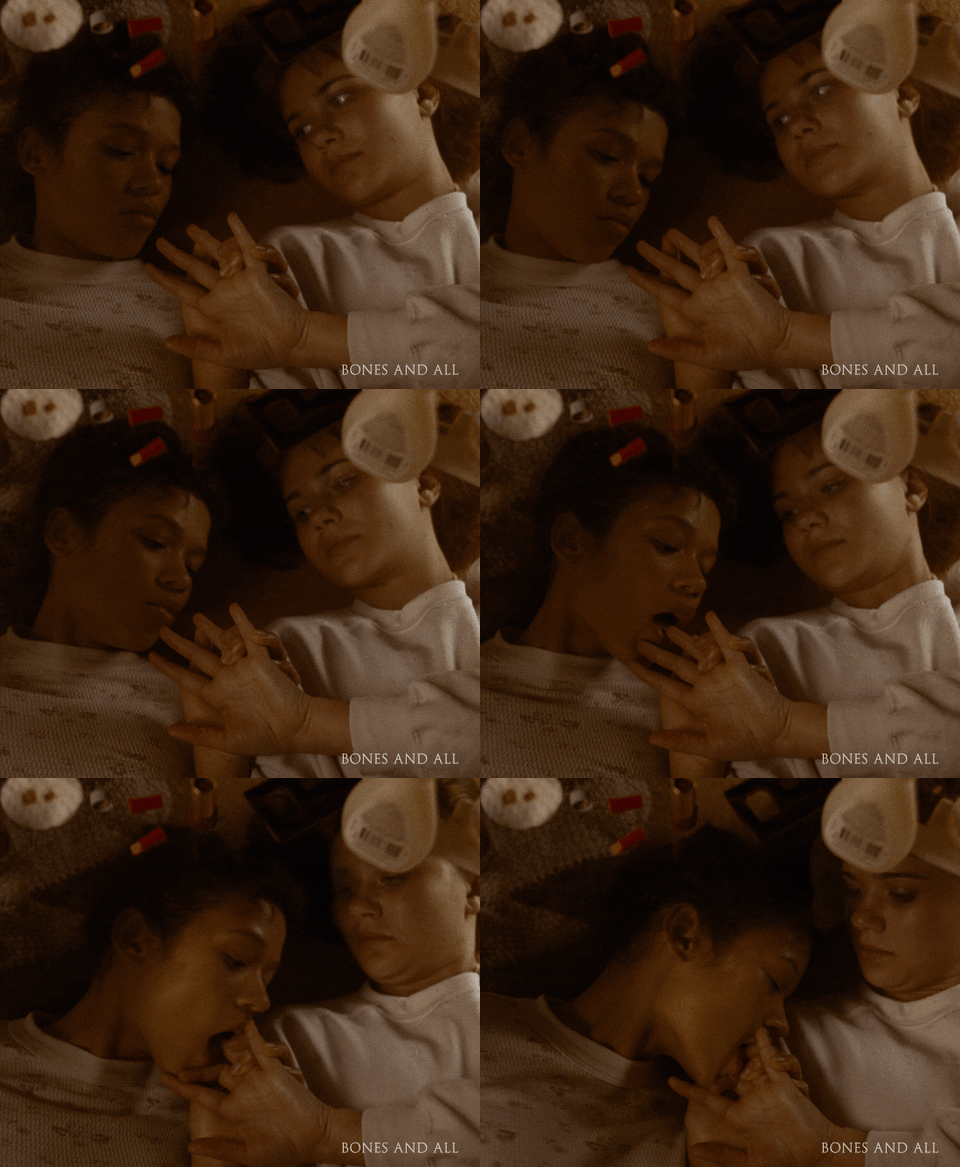
Guadagnino (usually) works in the opposite direction. A moment that a Disney film would cut to death becomes a heart-pound of energy in the form of a single shot. After sneaking around a creaky wooden house to evade detection, a heavy door slams shut in Call Me By Your Name. After a longing, appetizing stare, a cannibal chews off a friend’s finger in Bones and All. A horny boy stands, boner out, just to have it slapped by his best friend in Challengers. These moments would all be butchered to death with coverage and cuts by most filmmakers. Instead, these moments are memorable because Guadagnino chooses not to bludgeon the audience’s field of vision. In this way, Guadagnino at his best serves as a “curator” more than a “director”, gently guiding the audience’s attention to where it should be, as opposed to where it must.
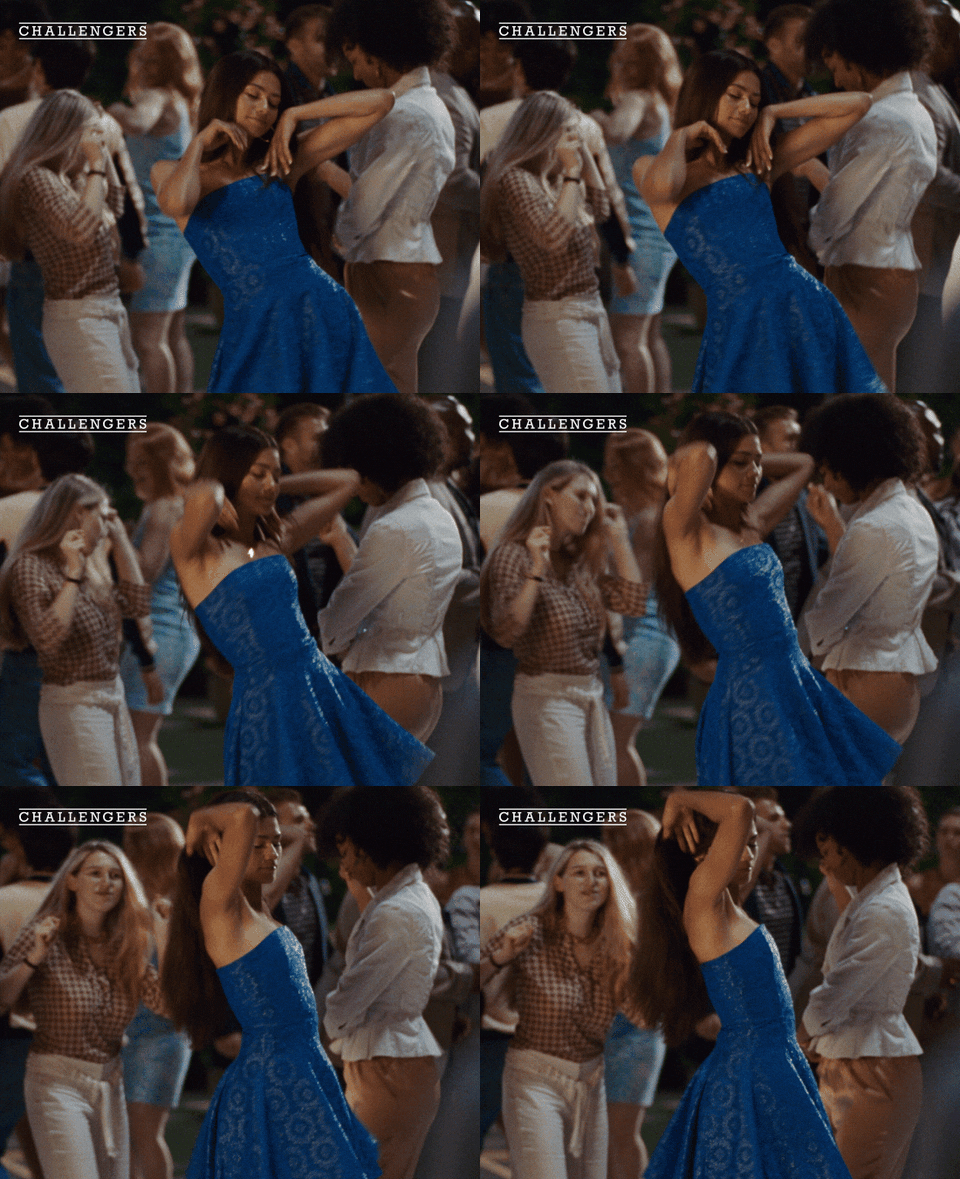
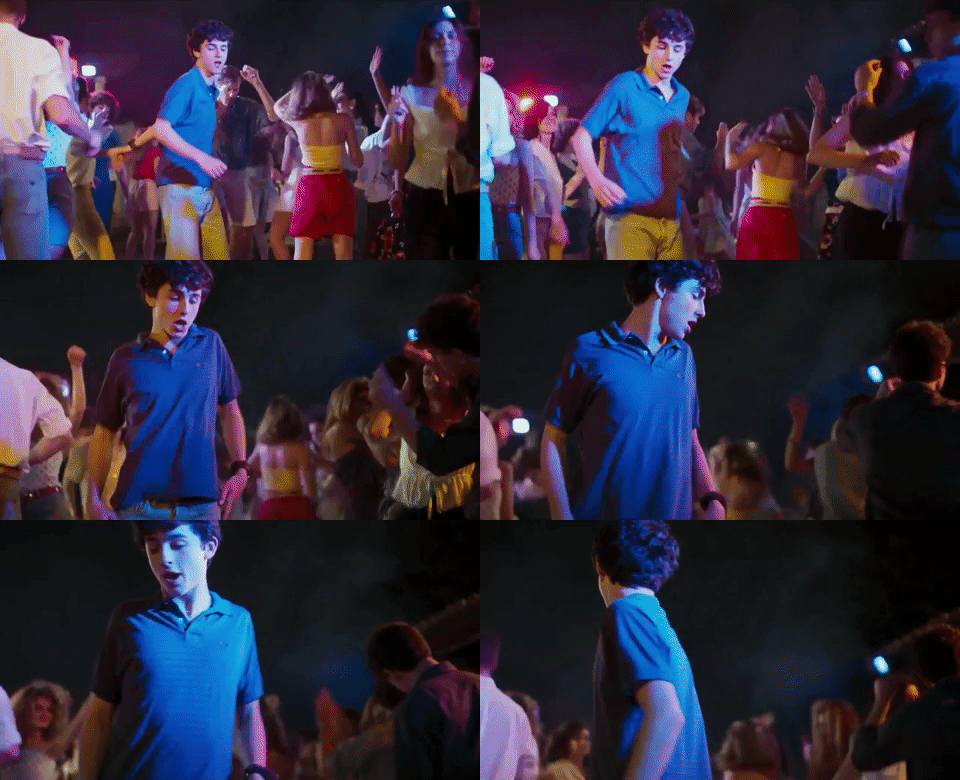
This belies a musical instinct in Guadagnino, one furthered by his insatiable use of music in his films, even his lesser ones. Timotheé Chalamet wouldn’t be in every goddamn film today if it weren’t for his impressive ending credits scene in Call Me By Your Name, but I believe that his dancing to “Love My Way” by the Psychedelic Furs was just as instrumental in cementing his star status. I couldn’t stand Bones and All; I thought it was self-indulgent, rambling, taciturn, and above all, not nearly as sexy as it wanted me to believe. However, I wouldn’t deny that I grinned from ear to ear as New Order’s “Your Silent Face” filled the otherwise quiet driving sequence like an endless expanse of clouds across the open road.
Challenging Forth
The Challengers movie score was a whole other ball game (pun intended) for Guadagnino. Working from a by-the-numbers script from Justin Kuritzkes (I read an early draft), Guadagnino needed music to fulfill a dual purpose of reinforcing the sexual tension between the characters whilst not distracting from those characters’ most intimate moments. To do this, Guadagnino enlisted Reznor and Ross to provide, “Driving, thumping techno, like a heartbeat that makes the movie fun.” “Very loud techno music through the whole film,” Reznor described as Guadagnino’s intention.
To achieve their productions, Reznor and Ross have a steadfast routine. They work weekdays between 11 AM and 7 PM, get at the philosophical essence of what they want to achieve musically, and then go through a fairly intuitive process of sonic selection and manipulation. This might seem strikingly ordinary for two artists who busted their chops on the outer most fringes of the mainstream for two decades, but it’s not particularly unsurprising. Trent Reznor and Atticus Ross are certified Hollywood royalty, and as such, finding fresh modes of creative inspiration may feel like an uphill battle.

Yet having a director aids in this process, especially one as passionate as Guadagnino. Luca himself was very involved in the creative process of the scoring. “ ‘Unending homoerotic desire.’ It was all a variation on those three words,” claims Reznor on Guadagnino’s notes for the score. Luca would also offer a writing credit to “Compress, Repress,” a deliciously absurd morsel of 80’s kitsch supplemented by Reznor’s earnest vocal delivery.
The Points That Matter
The Challengers movie score is beautiful. It’s loud. It’s a heartbeat in some moments (“The Signal”), achingly searching in others (“L’oeuf”), and above all, thoughtfully manicured. Is it fresh? Does it display a creative evolution past The Social Network? These are all maddeningly subjective questions that I’ve been wrestling with over the last couple of weeks.
The score certainly offers some technical strides in comparison to Reznor and Ross’s past works; the stereo images are more focused, the arrangements are more delectably layered, and the instruments themselves feel more deliberate. Is this a creative leap, or a sign that Reznor and Ross have a more expensive studio complete with a large army of underpaid assistants? Knowing the entertainment industry, it’s probably a combination of the two.
If there’s one serious qualm I have with the Challengers score, it’s that it displays the same compositional depth that Reznor and Ross have shown in their past work. My frustration with their lack of exploration beyond the dorian mode is as palpable here as it was when they got the Oscar in 2011, perhaps even more so now as a certified fan of their work. Yet I’m not letting any of this stop me from enjoying the Challengers score. If Reznor and Ross have shown one consistent point of excellence, it’s their ability to compose in musical terms a cinematic moment’s implicit emotional meaning.

This is why The Social Network, for all its Harvard and corporate legalese, feels like an emotional battering ram from start to finish. And it’s why Challengers feels just as musical during its dialogue-only churro scene as it does during its techno-addled tennis matches. The music screams during the film, jutting in at pretty arbitrary moments. Yet its presence isn’t as loud as its absence. Reznor, Ross, and Guadagnino are aware of the film’s signature enough to know when the club-ready score will feel most like a heartbeat, and when Guadagnino’s admiring lens plays a symphony of its own. In that way, I don’t think that much while I listen to the Challengers score. My heart’s racing too fast to intellectualize. And that’s an achievement.
Do you have a favorite moment from the Challengers movie score? Leave a comment below!


Leave a Reply