

This article was written by The Zillennial Zine’s spring editorial intern Henry Ryeder. Find him on Instagram at @henryryeder. If you would like to share an article with The Zillennial, send us an email at thezillennialzine@gmail.com.
The plain surrounded the house on all sides, its drab emptiness emphasizing the seclusions and mellowed magnificence of the villa. Here, in the garden, the air seemed brighter, the sun warmer, while the plain was always dull and remote.
– J.G. Ballard, “The Garden of Time”
When the theme for the Met Gala was announced on February 15th of this year, some understandable confusion ensued. While this year’s exhibit at the Metropolitan Museum’s Costume Institute, Sleeping Beauties: Reawakening Fashion, provided plenty of possible directions, the overarching theme was still a bit unclear. This is par-for-the-course for the Costume Institute, which often tenuously draws together a series from its mammoth collection with loose conceptual threads. The book of Sleeping Beauties‘ all-print exhibition text reads that the collection is dedicated to exploring fashion’s “rebirth, renewal, and cyclicity as well as its transience, ephemerality, and evanescence.” Whoever wrote that description should be given a crash course on redundancy, tautology, and wordiness.

Yet Anna Wintour, chairperson of the Costume Institute and mastermind behind the Institute’s annual fundraiser, the Met Gala, found an impossible through-line. The editor-in-chief of Vogue devised a theme that ostensibly aligned with the exhibit’s allusions to rebirth: “The Garden of Time.” A 1962 short story by renowned 20th Century writer J.G. Ballard, “The Garden of Time” tells the tale of a wealthy, insulated couple as an angry mob of peasants march toward their walled estate. The pluck of a “time flower” in their garden reverses time outside the castle, yet there are only so many flowers in the garden. The story ends with the desperate horde of humanity piercing through the fortress’s gates to find a decrepit ruin, two statues in the shape of the couple sit in the brush that once contained the time flowers.
You might be surprised that Wintour, in all of her salt-of-the-earth wisdom, didn’t wake up and smell the coffee. Over the last 15 years, the Met Gala’s increasingly become the “Western” world’s most expensive, debauched display of wealth and celebrity; a lavish flaunt of devil-may-carelessness as the world burns. The gala itself began in 1948 as a relatively low-key dinner and fundraiser for the newly formed fashion wing of the Metropolitan Museum of Art. During legendary fashion writer Diana Vreeland’s tenure, the Met Gala grew in cultural stature. By the beginning of Wintour’s reign in 1995, the Gala was already a preeminent event for New York’s elite.
Wintour supercharged the Met Gala’s prestige, artfully sewing celebrity seating charts like a Galliano “clochard” original. Wintour’s ability to weave the Met Gala into the writ-large cultural consciousness is widely recognized as her genius. In a 2015 documentary chronicling the development of the Costume Institute’s controversial China: Through The Looking Glass exhibit, then curator Harold Koda claimed Wintour, “Has understood that high fashion…when it’s paired with celebrity becomes something bigger than both.” This uncanny knack for fashion king and queen-making has served Wintour, the Met Gala, and celebrity culture quite well for nearly three decades.
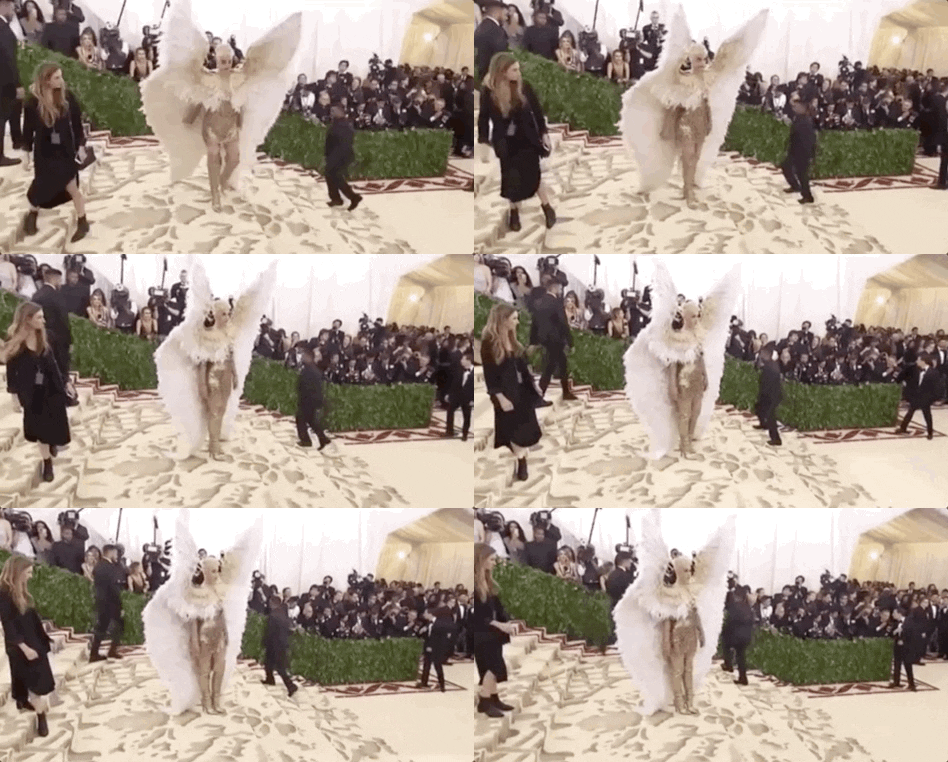
However, the last several years have seen Wintour’s savvy begin to collide with the cultural temperature itself. Wintour has undeniably fused high fashion and celebrity to create something greater than the sum of those parts. Yet as is the case with any empire, the garden of time doesn’t suffer fools gladly. The notion that the Met Gala would awe the world was correct; it may have been naïve to suppose that it could be controlled.
2011 saw one of the Costume Institute’s proudest moments. A little over a year following the suicide of world-renowned fashion designer Alexander McQueen, the Costume Institute put together a career-spanning exhibition entitled, Alexander McQueen: Savage Beauty. The critically-lauded and massively-attended exhibit was christened by that year’s McQueen-themed Met Gala, attended by the usual several hundred guests of cultural stature. In a contemporary New York Times write-up of the event, Cathy Horyn cheekily reminisced on encountering Donald Trump, fresh off the White House Correspondents Dinner that may or may not have influenced him to run for president in 2016. Regardless, the fundraiser held on the Upper East Side was a smash hit, hauling in $10 million for the Costume Institute.
Four months later and 110 blocks south, thousands of protesters gathered at Zuccotti Park. Chanting “We are the 99%,” the movement that would blossom into Occupy Wall Street grew in a context of political and economic instability. The further deterioration of the American Middle Class and public safety nets, a Great Recession spurred on by speculative recklessness and excess, and a political class that claimed to represent voters while cozying up to the wealthy, all coincided in the fireball of rage that was Occupy Wall Street. While the protest itself fizzled out within a few months, its utilization of online activism and expression of generational angst was a portent for things to come.
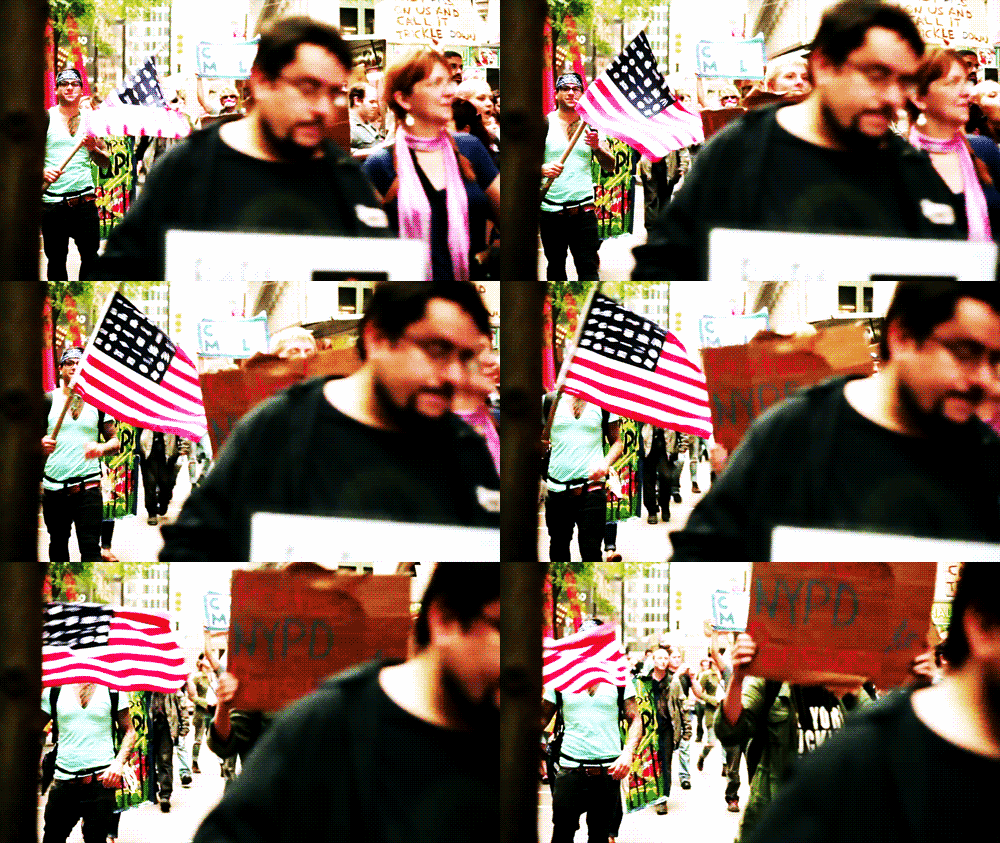
The cost for the Met Gala the following year was $25,000. While ticket prices began at an inflation-adjusted $647 in 1948, the exponential rise reflected both Wintour’s stratospheric vision and a runaway rate of American class inequity. In 2016, the same year that former Met Gala attendee Donald Trump successfully ran on a wave of Rust Belt fascist seduction to presidential ascension, tickets to the ball cost $30,000. In June of 2023, New York was cloaked in wildfire smoke from the Quebec region of Canada, an example of a Climate Crisis exacerbated by indifferent climate policies stretching back decades. Hospital intake for respiratory patients jumped 44% in New York City, where the average out-of-pocket cost for an emergency room visit is $1,825. Just weeks prior, the Met Gala was hosted by co-chairs including Dua Lipa, Roger Federer, and Penelope Cruz. The ticket price was $50,000.
How much does it cost to attend the Met Gala in 2024? Tickets now cost a whopping $75,000. Considering that there were around 400 attendees this year, it’s safe to assume that attendance costs ranged around $30 million in total. This is commensurate with a recent estimate of a $26 million fundraising haul for the Met Gala, a new record for the event.
Yet 2024 was an entirely different ballgame for the Met Gala. A live-streamed genocide in Palestine at the hands of Israeli militants and American weaponry sent the Western world spinning into political division. With the hypocrisy of U.S. foreign policy on full display, resistance to the genocide led to some of the largest mass-protests in history. Protests soon spread to the campuses of Western universities as students urged that their academic institutions divest from corporations based in Israel. Considering the overwhelming support of the Free Palestine movement among young people, one might assume that America celebrities would heed the calls of their coveted 18-24 year-old market demographic.

Nope. The vast majority of film stars and pop stars in the United States have largely followed one of three camps. The first camp is direct and vocal support for Israel’s apartheid and ethnic cleansing operation (an open letter stating as much was signed by literati luminaries such as Jordan Peele, Taika Waititi, and David Lowery.) The second camp is glib, cursory, or second-hand references to the “humanitarian crisis” (offering a screenshot and repost here or there, all while stopping short of being fully vocal.) The third camp is total silence.
Not particularly surprising, this last camp comprised many attendees for 2024’s Met Gala. The humanitarian indifference of the gala’s celebrity guests crashed head-on with a generation full of apoplectic political furor. This resulted in “Blockout 2024,” a trend on TikTok (whose CEO ironically co-chaired this year’s Met Gala) in which users on the app blocked Met Gala attendees who have stayed silent on Palestine. This list includes Harry Styles, Drake, Justin Bieber, Kim Kardashian, Jojo Siwa, Shakira, Kylie Jenner and Taylor Swift.
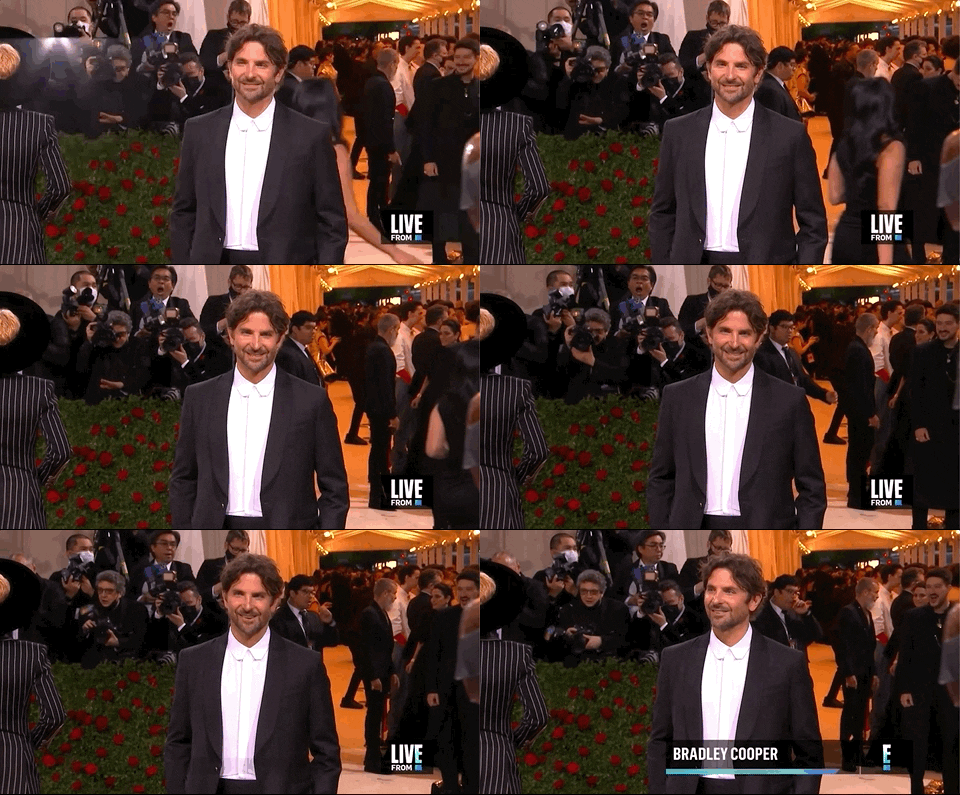
While several of these celebrities didn’t actually attend the Met Gala this year, their presence on the list speaks to the unintended consequences of Wintour’s machinations. For all her brilliance, Wintour obviously didn’t foresee the Met Gala’s prestige becoming synonymous with all that’s wrong with American wealth and celebrity culture. As an annual event, it’s also fascinating to see the Met Gala’s public perception change from year to year. While obviously a puff piece, the aforementioned documentary The First Monday in May shows a delighted crowd of celebrity sycophants awaiting the stars across the street from the Metropolitan Museum. This year, images showed protesters being pushed away from a barricade of smiling cops.
One moment in particular stuck out to me during The First Monday in May. Famed director Kar-Wai Wong rides in a car with exhibit curator Andrew Bolton as he hears Bolton’s dizzying (and downright insensitive) ideas for the Through The Looking Glass exhibit. After Bolton blithely exclaims, “There’s a lot to see,” Wong responds, “Seeing too much is seeing nothing.”
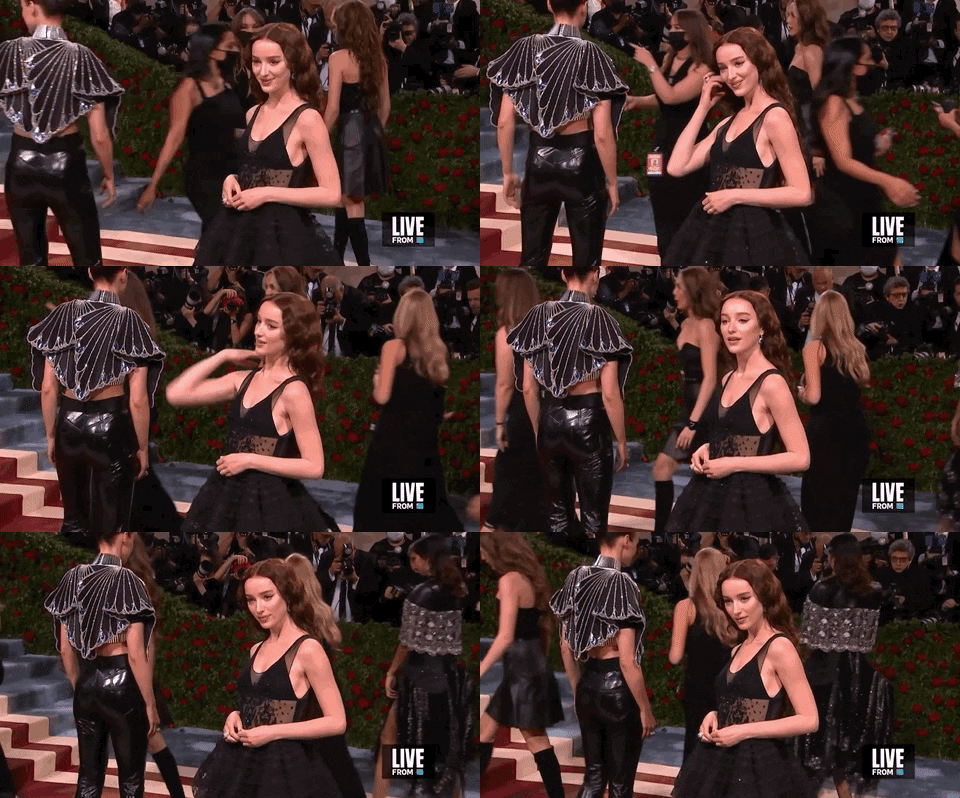
The Met Gala is a seductive spectacle, one that teases plebeian aspirations with a contrived idea of culture and wealth at its most heightened and refined. Yet, even in this dazzle of so much wealth and so much exploitation, very little feels intentional. Wintour was quick to apologize this year, not for the ticket prices, or for hosting a gala during a genocide, but for the theme. “The exhibition broke my cardinal rule,” Wintour stated, noting that the theme of the evening “Could be about many, many things.” In other words, so much is put on display, that the hollowness of it all is put into stark relief.
Inadvertently, Wintour’s apology encapsulates so much of this moment. We’re shown so much constant information that any display of pomp and circumstance feels hollow. Wintour and Bolton’s choice of using a Proto-Marxist class commentary to provide further guidance seems absurd; Ballard after all is arguably most famous for a satirical Vietnam-era short story titled “Love and Napalm: Export U.S.A.” Yet in the context of an aging cultural juggernaut buckling under the weight of its own trappings, The Garden of Time might have been the perfect theme.

A lush display of wealth that occurs under all circumstances, the Met Gala is in and of itself a garden of time. Each year, a flower is plucked to push the revolution further back across the dull plain surrounding the castle. Each year, the mob grows closer. Who knows how many time flowers are left?
What are your thoughts on the Met Gala this year? Leave a comment below!


Leave a Reply