

This article was written by The Zillennial Zine’s spring editorial intern Henry Ryeder. Find him on Instagram at @henryryeder. If you would like to share an article with The Zillennial, send us an email at thezillennialzine@gmail.com.
The word “climate” doesn’t appear once in a Taylor Swift song. Not in the nearly 80,000 words comprising every Taylor Swift recording from 2006 to 2023 does the word “climate” appear.
That probably doesn’t come as a surprise. Taylor Swift is a pop songwriter, and she isn’t particularly known for a Joan Baez-style call to action or a We Are The World-style glam altruism. Nonetheless, it’s striking that a word that Taylor has rarely uttered publicly, much less in her songwriting, has become synonymous with the pop star. Through her refusal to take (or even feign) accountability for her disproportionate contribution to Climate Change, Taylor Swift has deservedly gotten flack.
Even still, Taylor Swift is one of the most, if not the most, famous artist on the planet. Like any politician, it’s easy to project our woes, angers, and hatreds onto Taylor because she is so culturally ubiquitous. The real Taylor Swift, whoever she may be and whatever she may believe, gets lost in translation. The real Taylor Swift is also responsible for her actions.
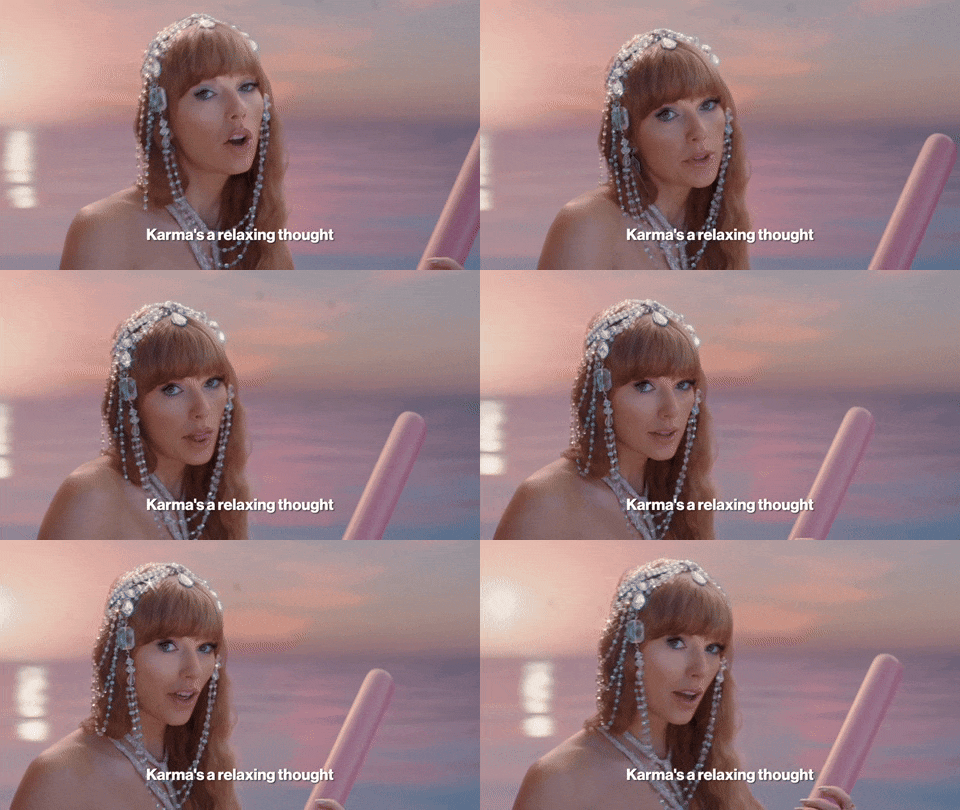
Taylor Swift is currently the number two streaming artist on Spotify, an achievement underscored by her years spent railing against that platform for its refusal to better compensate artists. Recording from the age of 16, Taylor’s transformation from a country-pop artist singing about Tim McGraw to effortless romantic with Love Story and You Belong With Me, to full-fledged pop superstardom with 1989 is nothing short of astounding. There’s no doubt concerning Taylor Swift’s effortlessness with writing melodies, they have a sweetness and brightness entirely to their own. Listening to Swift’s work from what I consider her strongest years, 2009 to 2015, is like the sensation of drinking a Cherry Coke at the movie theater. There’s a reliable charm that’s both nostalgic and current. It’s simple, elegant, and confident; you know you’re in the hands of an expert pop star.
Yet Taylor Swift’s popularity, something that’s only ballooned as the years have passed, has come at a price. When you beat out Vladimir Putin and Xi Jinping to become Time’s Person of the Year, you’re bound to come under constant scrutiny. As last year’s (and human history’s) biggest, most lucrative musical touring act, Taylor Swift’s every move is incredibly visible, they’re also incredibly big.
The Eras Tour employed somewhere between 50 and 90 semi-trucks to transport equipment between Swift’s US tour dates. Travel to and from the Eras Tour for worldwide concertgoers was often extreme, leading many to purchase flight tickets to and from their home cities in order to see Swift perform. Climate Change was also an issue at Swift’s performances. 23-year-old Ana Clara Benevides Machado died due to complications relating from heat exhaustion following Swift’s concert in Rio de Janeiro, Brazil.
When the Eras Tour arrived in Auckland, New Zealand, it transported tour equipment in two Ukrainian Antonov (yes, they’re really called “Antonov”) planes. These planes are often used to transport military equipment, and consume a hefty 12.6 tons of fuel per hour. Taylor’s own personal Dassault Falcon jets racked up 166 hours of flight time in the first six months of the tour.
While it’s difficult to calculate the Taylor Swift carbon emissions 2023 stats specifically from these hours of flight time, an investigation done in 2022 puts Swift’s private jet carbon footprint into starker detail. In a report conducted by the Yard of the ten celebrities whose jet-setting carbon footprint are the most egregious, Swift easily topped the list with a whopping 8,293.54 tonnes in 2022, over 1,100 times more than the total carbon footprint of the average human in a year.
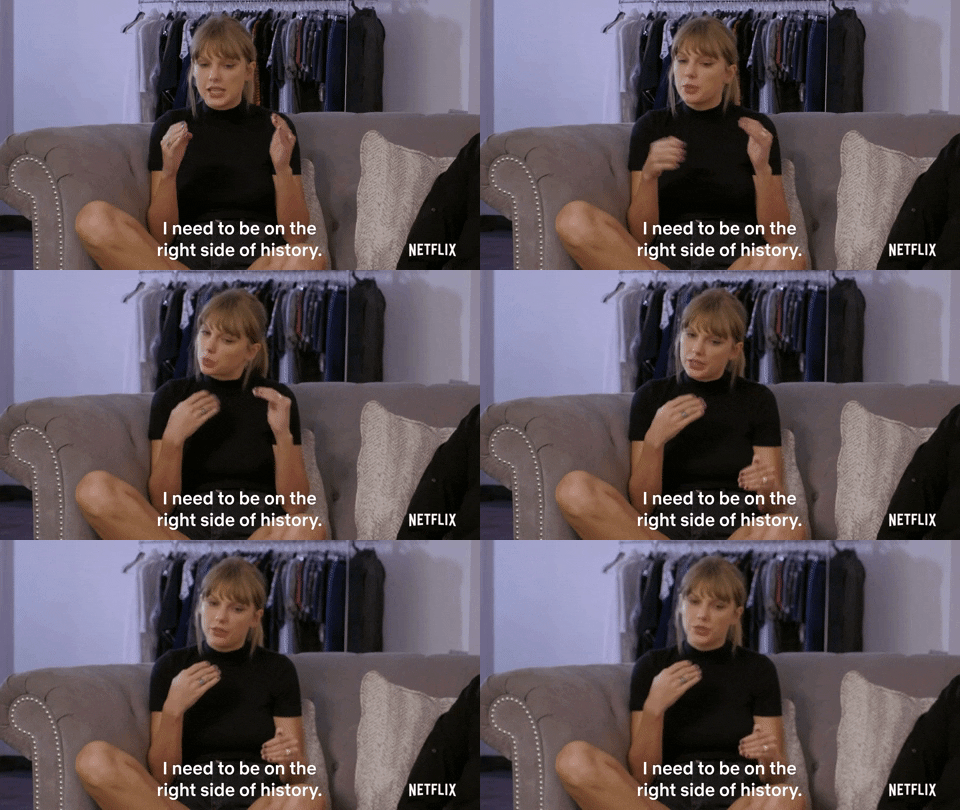
In case you don’t remember, this caused quite the uproar among fans, pop-culture aficionados, and climate activists alike. The discourse was ratcheted up a few metric tonnes when a spokesperson for Swift stated, “Taylor’s jet is loaned out regularly to other individuals. To attribute most or all of these trips to her is blatantly incorrect.” This was met with incredulity by many, who pointed out that to most human beings, loaning out goods or services doesn’t absolve culpability. If I were to give someone my credit card, I’d still be responsible for a $1,000 charge.
The conversation about Taylor Swift’s carbon footprint evolved into a conversation about corporate environmentalism itself. Spokespeople for Swift have been quick to defend her actions by pointing out that she had purchased carbon credits to offset her environmental impact. One can understand the idea behind carbon credits as a security-based analogue to carbon capture. When a credit is purchased, the equivalent of a metric tonne of carbon emissions is supposedly offset by an investment in alleviating a metric tonne of carbon emissions from the atmosphere. The trouble with this logic is that planet Earth doesn’t operate like a marketplace with overseers determining the credit value of a loan. Claiming that my money will remove a metric tonne of carbon from the atmosphere is easy; more importantly, no one’s going to stop me from doing so.
And like most corporate investments in the environment, a cursory look under the hood shows that checks and balances are hard to come by. A report conducted last year by the Guardian showed that 78% of the most popular emission offset programs were categorized as junk, in that they showed fundamental failings in offsetting carbon emissions. Another report showed that 90% of offset credits by leading carbon credit “verifier” Verra were completely worthless, having no impact on carbon reduction whatsoever. If this seems like all this doesn’t have a lot to do with Taylor Swift, you’d be right. If this seems like it has a lot to do with Taylor Swift, you’d also be right.
While many of Swift’s fans reliably rallied to her defense, many recognized the reality of Swift’s carbon footprint while also remaining admirers of her work. This latter reaction is a difficult, mature human feeling to express, and much more difficult to express in under 200 characters. Naturally, internet discourse portrayed the issue as a battle between Swift and everyone else.
This is the part where Taylor Swift’s relationship with the internet becomes acutely relevant. Perhaps the first major pop star to be chronically mired in drama played out mostly online, Swift’s reputation over the years has often been a dizzying West Side Story-style dance-fight between Swift, her most loyal companions, and whatever America happens to be thinking about (most often white) womanhood. This is why Taylor Swift’s possible queerness can be written about verbosely in the New York Times editorial section, and why Taylor Swift’s economic impact can be discussed by Paul Krugman, also in the New York Times editorial section.
Personally, this relationship between Swift, her fans, and American culture became most painfully visible in 2016, when at the height of her superstardom and relevance, Kanye West and Kim Kardashian seemingly undid it all with one move. In his career-defining (pre-Alex Jones) album Life of Pablo, West included in his song Famous the egregious line, “Me and Taylor might still have sex, I made that bitch famous.”
The song went viral. An insanely creepy music video featuring a naked Taylor Swift doll in bed with West was posted by the artist. College-level celeb-du-jour Aziz Ansari posted a video with he and Master of None comedic sidekick Eric Wareheim dancing and lip-syncing to the song, cementing the line’s bizarre place in acceptable public discourse. Swift responded to the song somewhat circuitously during an acceptance speech at the Grammys in February of 2016, implying that West was trying to take credit for Swift’s hard work. You can, and I have, thought a lot of things about Taylor Swift. I thought, and still think, that in this case, she was absolutely right.
For many reasons, the cultural pendulum of 2016 swung away from siding with Swift. After West and then-wife Kim Kardashian posted a video showing Swift approve of part of the song’s lyrics, much of the internet seemingly sided with West. I remember the climate (no pun intended) at this time, and was baffled as to how my generation, that was ostensibly so gung-ho about respecting women, could not only excuse West’s line, but also use it as a punchline against the most famous femme artist in the world.
Yet years later, it’s easy to see that this “doublethink” is a huge part of Taylor Swift’s relationship to culture. As one of the most famous people on the planet for the last decade, and arguably the most one famous artist currently, Taylor Swift seems contradictory in part because we are contradictory.
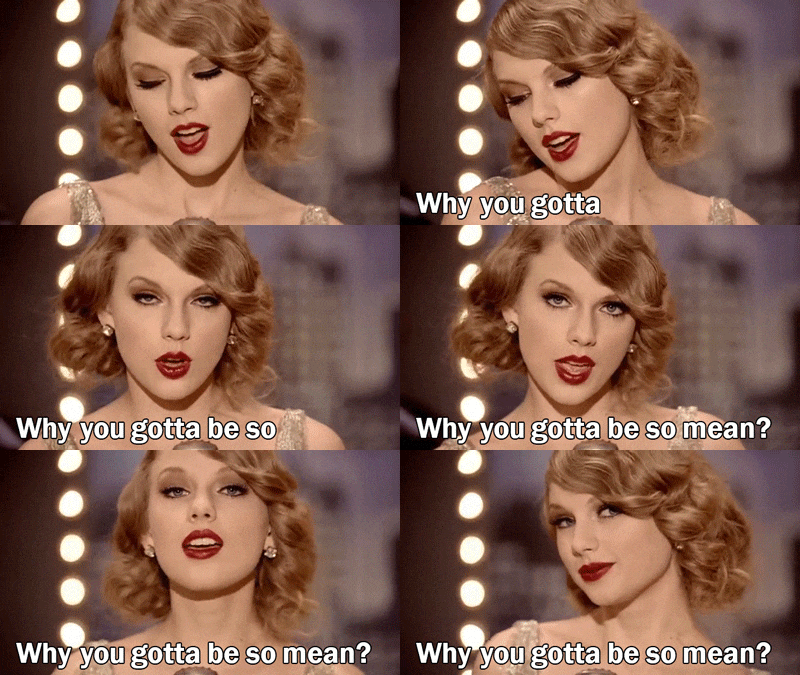
At the beginning of this piece, I likened our relationship with Taylor Swift to that of a politician, and that’s true to a point. Yet it’s important to distinguish Taylor Swift from the competition she bested for Person of the Year in 2023, and some of that title’s recent winners. Swift didn’t sow political divide in the West so she could start a land invasion of Ukraine, she didn’t buy the internet’s “town square” only to have it devolve into a hell-scape of vitriol and hate speech, and she didn’t lead an insurrection on the Capitol. Taylor Swift is an artist, albeit a multi-billion dollar one. Yet because she runs through so many cultural veins, it’s easy to talk about her like we talk about the world. What does it mean that we’re talking about Taylor Swift’s carbon footprint rather than Steven Spielberg’s? Why were the Beatles never implicated for jet-setting around the world? Was it a different time when wealth was less lopsidedly distributed, or is it just because the Beatles were men? If Taylor Swift were Black, would she be the New York Times darling she is? Is Taylor Swift’s privilege and wealth intrinsically part of her brand, or did she work for her fame?
The answer to all of these questions is ‘yes’…and ‘no.’ Taylor Swift is an icon, something we enshrine and burn in effigy in equal measure. In both cases, we end up licensing her image, making the real Taylor Alison Swift more powerful. It’s important to remember that the real Taylor Swift is a human, the same one that’s had to withstand enormous pressure her entire career from a misogynist world that wants to hold her up in one instant and bring her down the very next. That real Taylor Swift also makes her own decisions, like the decision to be the world’s biggest touring act in a fossil-fuel economy at a time when Climate Change threatens our species’s survival.
If there’s one through-line between our discussion of Taylor Swift as a celebrity and a person, it’s that regardless of the discourse, there’s a clear-cut generational divide. Previous generations, the same ones who are likely to read the New York Times editorial section, might tend to see world events as decided by governments and leaders, out of the hands of individuals. To a generation raised on the idea that everyone is a brand, that everyone has a voice and identity, it’s easier to accept that everyone can and should be held responsible for their impact on the planet.
I’ll end with a recent and brilliant quote by Meghan Horgan from the Hard Times. In her satirical piece following the announcement that Taylor Swift had officially been valued as a billionaire, Horgan wrote from the fictional perspective of a “progressive” Swift fan, “I’ve tweeted ‘All Billionaires should have a date with a guillotine.’ I’m hoping this is all a clerical error and Taylor still just has 999 million dollars.” Our understanding of Swift as hero or villain may forever hinge on that one penny.
What do you think of the Eras Tour and the Taylor Swift carbon emissions 2023 stats? Are you pro-Taylor? Anti-Taylor? Do you just wish all this bickering would stop!? Leave a comment below!


Leave a Reply