

This article was written by The Zillennial Zine’s spring editorial intern Henry Ryeder. Find him on Instagram at @henryryeder. If you would like to share an article with The Zillennial, send us an email at thezillennialzine@gmail.com.
I’m having a real winning streak with the New York Times. Just today, the Zillennial Zine wannabe published an article on the “Mob Wife” trend on TikTok and Pinterest, just as I was starting to write this article. Maybe I have a sixth sense for the neoliberal, maybe Ezra Klein is scouring Gen Z rants for more polling data, or, perhaps most likely, “Mob Wife” really is that popular right now.
It wasn’t too long into the first weeks of the new year before search results for cheetah and leopard prints skyrocketed on Pinterest and TikTok. Makeup and dress tutorials followed suit, and “Mob Wife” became the aesthetic rallying cry for 2024 within days.
What is Mob Wife? It’s both deliciously simple and stupidly hard to pin down. For reasons that deserve a library section, Italian American organized crime is a cultural touchstone; a set of tropes, stereotypes, and caricatures that most any citizen can recognize. Its glory days long in the past, we can point to “the Mafia” as a treasure trove of colloquial and aesthetic chess pieces that have powerful connotations without the weight of lived experience. Yet while the Mafia usually conjures images of scrawny, slick-haired Italian men in cheap suits chomping on cigars as smoke bleeds into their baggy eyes (I promise I’m not trying to describe myself), Mob Wife turns the attention to their colorful spouses.
Luckily for culture, the stereotype of the Rambunctious Italian has no gender discrimination, a hallmark of progressivism that doesn’t usually extend to us Italian Americans. Nonetheless, the stereotypical wives of mafiosos are iconic themselves: intelligent, but vain, bombastic, but calculated, complicit, but chic.
As an Italian American myself, I have some uncommonly sensitive feelings about the portrayal of Italian American men and (mostly) women on reality television, but one thing I never question is the appeal. The stereotype is naughtily empowering. Stereotypical Italian Americans are open about the shallowness that sold their ancestors on sailing over here in the first place. And what do they get for their honesty!? Ok, I’m starting to sound like a junior mafioso myself, so I’ll cool it.
The fact remains, Italian Americans (and by proxy the Mob, their all-consuming caricature) have carved out a discomfiting place in the national consciousness: what I’ll refer to as “off-white.” More than a hundred years before Tony Soprano declared, “In this house, Christopher Columbus is a hero,” President Benjamin Harrison urged Americans to celebrate the newly official Columbus Day in response to a lynching of Italian American immigrants in New Orleans. This event wasn’t uncommon; darker-skinned Southern Italians were routinely viewed as nonwhite upon their arrival to the United States. This prejudice is part of a larger, centuries-long ethnicization among those of Italian heritage: that the lighter-skinned Northerners are superior. It’s a prejudice that family members tried to instill in me as a child, and one I honestly forgot about until conducting research for this article.
In spite of, or most likely because of their ostracism, Italians in immigrant neighborhoods found capitalist success through criminal means. In the 20th Century, this evolved into the Mafia, a highly efficient, stratified system that became publicized, litigated, and ultimately baked into the social consciousness of the United States. Through Christopher Columbus, Italian Americans were able to edit themselves into the mythology of colonialism. Through the mafia, Italian Americans were able to become an American myth unto themselves: something that only America could create, like the lightbulb or Rock ‘N Roll.
And still, they’re a caricature. The Mafia, and Italian Americans, are culturally viewed as a proxy for how white America views itself. I want to clarify that this doesn’t mean that Italian American stereotypes are exclusively enjoyed by white people; or that Italian American organized crime is anywhere close to the most rich or interesting cultural mafia in the world. Still, in their rapid assimilation into white privilege during the 20th century, Italian Americans saw the American Dream transform in violent, visceral fashion. In this way, Italian American culture becomes a funhouse mirror to understand the entropy of tradition in a consumerist world.
“It corrupts and degenerates,” Martin Scorsese said of consumer culture while promoting Goodfellas in 1990. When explaining the motivations of the film’s protagonist, Henry Hill, Scorsese cheerfully stumbled for the right words, explaining that Henry just wants to buy bread for his mother. Eventually he settled that, “It’s the American dream.” This is nearly two decades after Francis Ford Coppola’s The Godfather. In his delightful The Kid Stays In The Picture, The Godfather producer Robert Evans recalls hearing Coppola explain that The Godfather is “a metaphor for capitalism in America.”
So there you go. While the Mafia may seem like an unlikely candidate, it serves as an eternal projection of modern America’s hollowness and helplessness. Which brings us back to the Mob Wife, the oft-domestic (but impossible to tame) femme counterpart to the big bad mafioso. I’m going to list my favorite female characters from least to most, and describe why they top the list. Please keep in mind that these are all fantastic performances; my preference lies in the film’s extension of sympathy toward the character. While you read and choose your favorite, I implore you to think about the Mob Wife trend. Marketing ploys notwithstanding, mafia narratives often fall into favor during moments of American self-reflection. Why now?
#5. Naomi Lapaglia – The Wolf of Wall Street
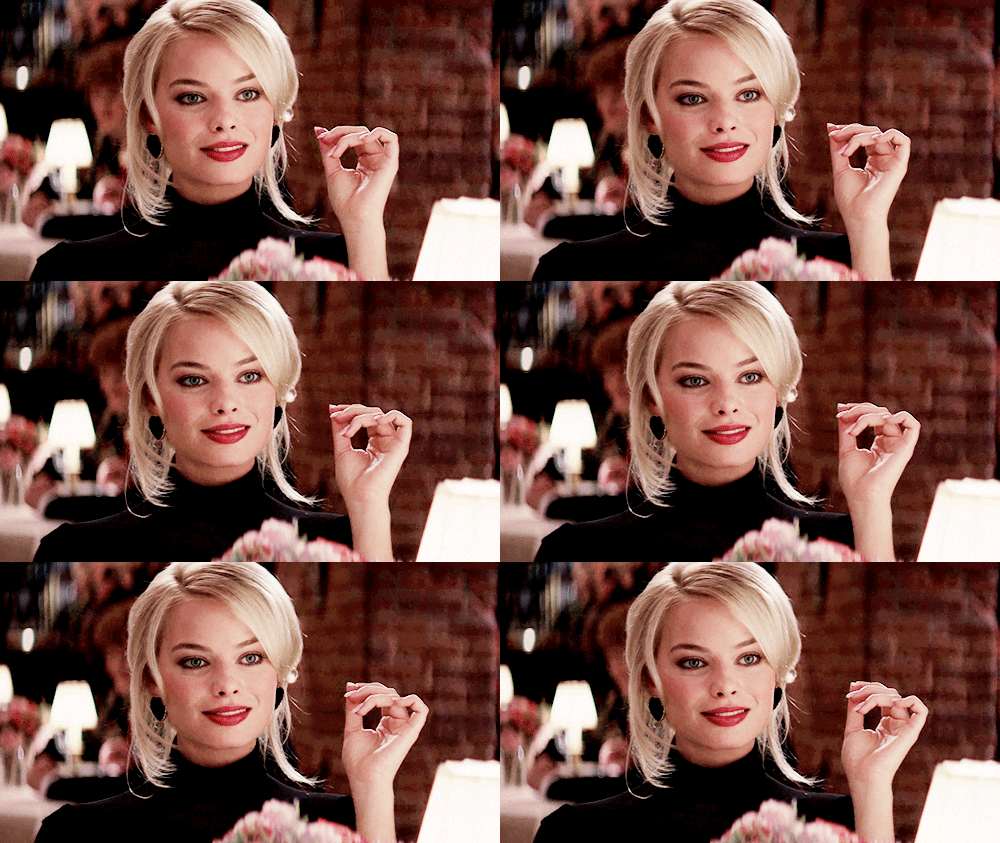
Margot Robbie’s show-stopping film debut made her a worldwide star overnight, and for good reason. Naomi Lapaglia, based on real life Nadine Macaluso, is a Bay Ridge model-turned-socialite upon her marriage to foul-mouthed schemer Jordan Belfort, played by Leonardo Dicaprio. Naomi is such a quintessential mob wife that it was impossible for me to exclude her from the list, and she does have some excellent scenes.
A blowup fight that starts with Naomi pouring water on Jordan has the emotional arc of something only Italian Americans can muster. Naomi’s pleas for Jordan to get his act together and parent their child are answered with coldness. Jordan is the breadwinner, and in his mind, that’s all that should be expected from him. It’s Naomi’s following scene, during which she uses her sexuality to attempt to persuade Jordan to be more responsible, that became synonymous with the film. I think that’s a shame. Naomi shows her motivations in many moments throughout The Wolf of Wall Street and the film could have focused on those moments more than guffawing at her seductive power. Still, Margot Robbie steals the show during these scenes.
#5. Kay Adams – The Godfather: Parts I, II, (and I guess) III
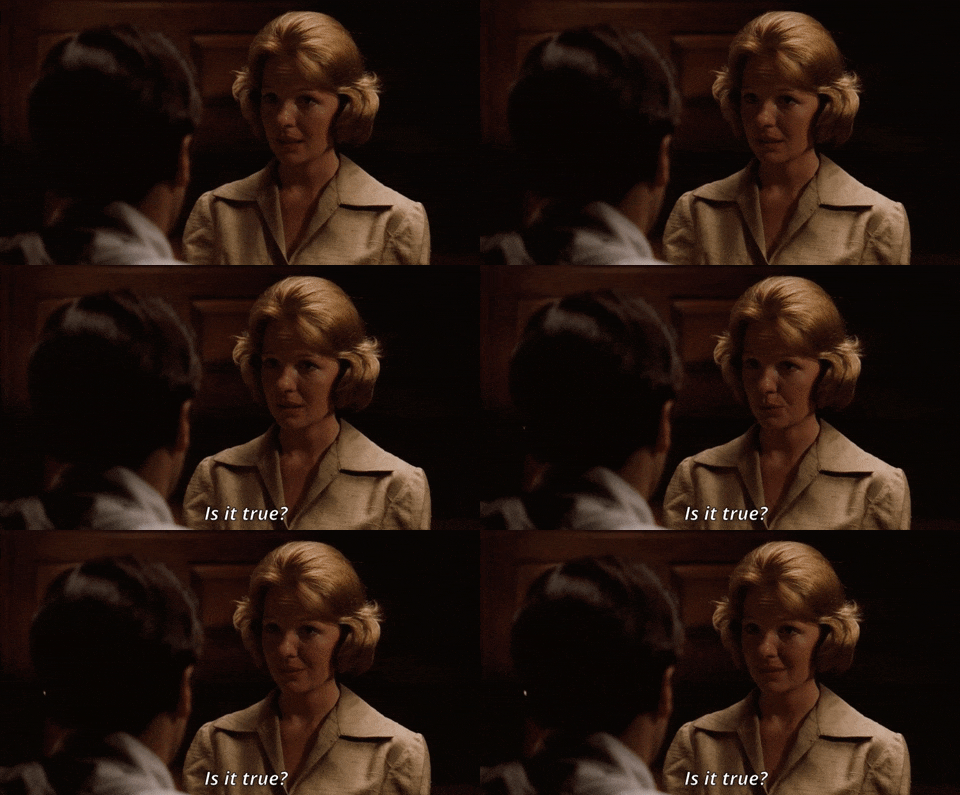
Yeah, yeah, yeah, the door closing in on her in the last shot is a metaphor for the closed doors of power and blah, blah, blah. I went to film school so I won’t clobber you over the head with that bit (righting a wrong done to me), but Diane Keaton’s Kay Adams is a particularly interesting Mob Wife character. Unlike the others on this list, Kay isn’t flashy, gaudy, or loud. In Hollywood terms, and in the world of the film, she’s not Italian. Kay is WASP-incarnate, the daughter of a Baptist pastor from New Hampshire, and a schoolteacher to post-war suburban Baby Boomers.
This is exactly the kind of woman that family black sheep Michael Corleone would fall for. An enlisted man when his family assails the war effort, Michael wants nothing to do with his crime boss father’s business, yet he finds himself the only one capable of taking the helm when his father is shot. The final scene of The Godfather: Part I is Kay’s most famous, but my favorite is one prior, during which Michael tries to convince a frightened Kay that he’s no different from any senator or president. With all the John Philip Sousa gusto in the world, Diane Keaton’s Kay replies, “Do you know how naive you sound, Michael? Presidents and senators don’t have men killed.” Al Pacino’s Michael replies, “Oh. Who’s being naive, Kay?”
Again, the Mafia is an allegory for America’s relationship with itself. The failing of The Godfather with Kay is its refusal to afford her any agency in the story. Coppola was at least aware of this, and it’s a testament to his labyrinthine attention to detail when he revealed several years ago that casting Keaton was a conscious decision to make the role of Kay more interesting. If only he could’ve gotten around to that on his typewriter instead…
#3. Angela de Marco – Married to the Mob

Jonathan Demme’s delightful Married to the Mob features a fantastic performance from Michelle Pfeiffer as Angela de Marco, a Long Island mob wife whose life is turned upside down when her up-and-coming mafioso husband is murdered by Tony “The Tiger” Russo. Tailed by cops on one end and harassed by a lecherous Russo on the other, Angela has to make life work for she and her child in the big city. Pfeiffer is excellent in this movie and the scenes in which she struggles to make ends meet show some of the best 80’s New York footage I’ve scene.
These moments also showcase the film’s understanding of Angela as a human being. Watching Angela come undone as she begs a hair salon to give her a chance is genuinely heartbreaking, yet in the cadence of a classic mob wife, there’s always a tinge of irony. This balance between sincerity and winking humor is terrific. Unfortunately, a lot of the good will of the film is undone by Matthew Modine’s creepy and leering Agent Mike Downey, whose stalking is made legitimate by way of his badge. I don’t disbelieve that Downey could be charming to Angela, I just wish the film worked a little harder to convince me. Nevertheless, Pfeiffer is gold.
#2. Karen Hill – Goodfellas
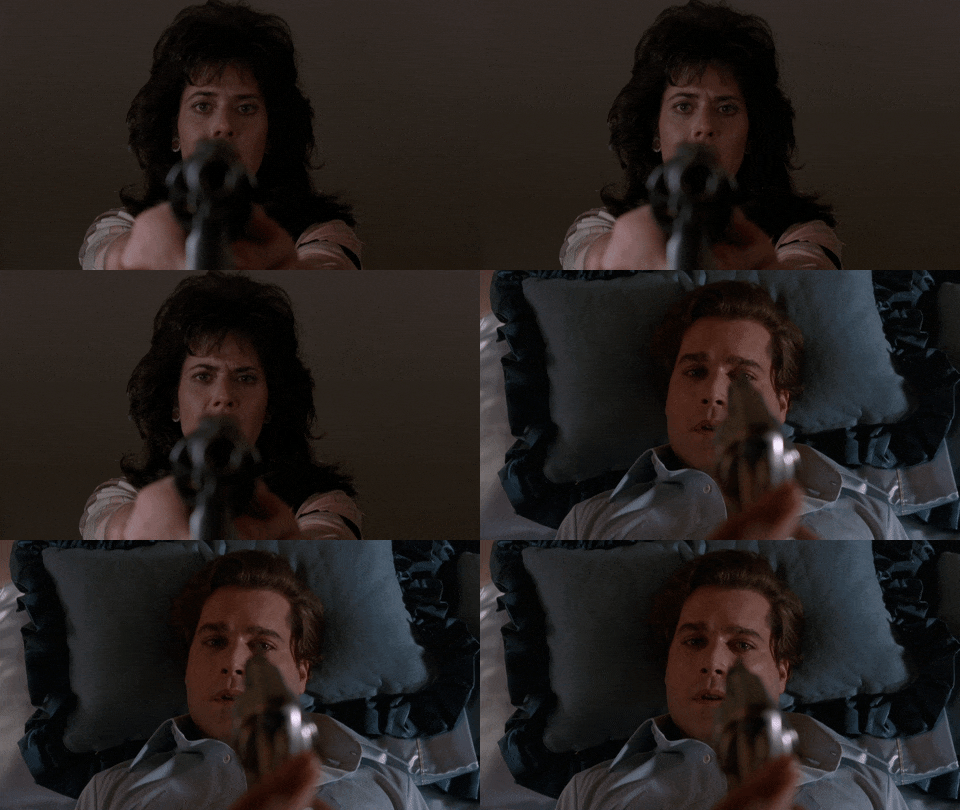
“I know there are women, like my best friends, who would have gotten out of there the minute their boyfriend gave them a gun to hide. But I didn’t. I got to admit the truth. It turned me on.” There’s never been a moment in my ten-plus years of watching Goodfellas when I doubt the complicity, intent, or motivation of Henry Hill’s wife. While she’s not a member of the mob’s patriarchy, she benefits from its every twisted move. Maybe it’s no coincidence that her name is Karen…
Lorraine Bracco is stunning as Karen, the Jewish-Italian-American who marries Henry Hill and becomes a part of his endless, reckless gallivanting in the world of organized crime. At every turn, Karen makes Henry’s business her business. She hides his drugs, money, and in one unforgettable scene pulls a gun on Henry, whom she believes is cheating (spoiler, he is.) When Henry’s in prison, she smuggles in luxury goods to make his stay enjoyable…until she slams them on the table in a delicious show of fury.
Karen’s steadfast commitment to Henry throughout his gross (and often abusive) mistreatment may be construed as realistic, but it’s doubtlessly tragic to watch. In general, I find it harder to enjoy Goodfellas as I get older. I could certainly be overreaching, but some part of me feels as though this was intentional on Scorsese’s part.
#1. Carmela Soprano – The Sopranos
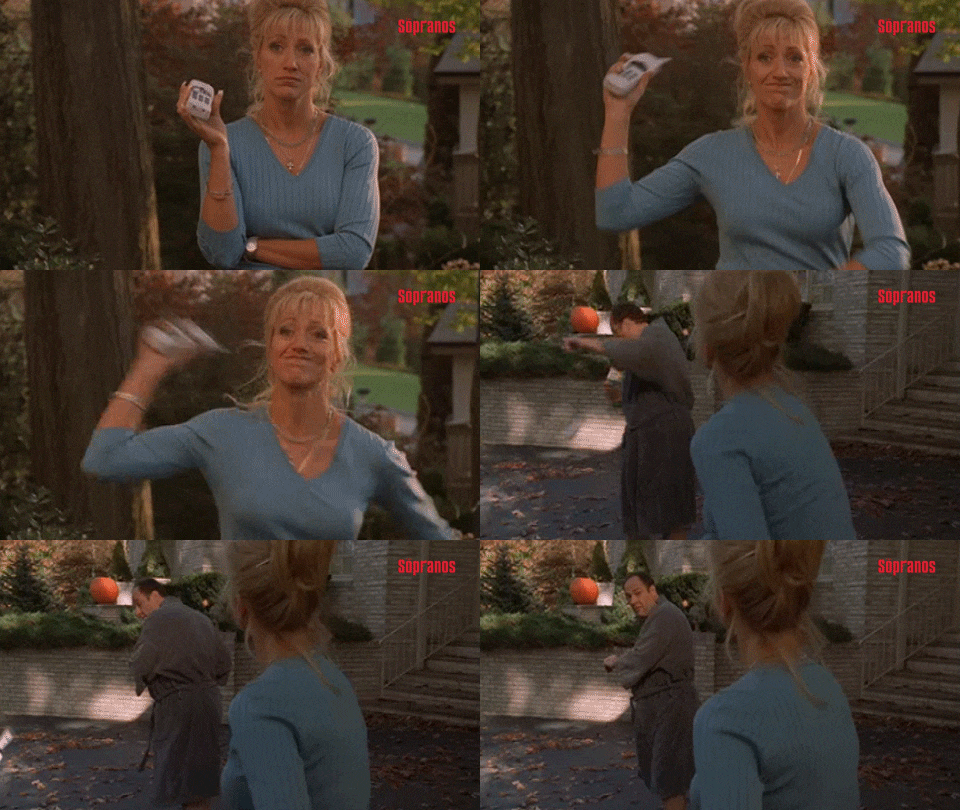
Ok, I get it, not a movie! Regardless, Edie Falco’s Carmela Soprano is undoubtedly the most influential mob wife of all time, not to mention the most human.
Sporting an iconic wardrobe of late 90’s to mid 2000’s apparel, Carmela’s journey is one of the most believable character transformations in television history. Beginning as the devoted mother to their young children, Carmela might not be entirely convinced that her husband is faithful, but she’s willing to play the game. The hungry late-night visits of a handsome, young priest seem to satiate Carmela until she realizes that no man in her life is smarter than she.
Her independence from mob boss husband Tony climaxes in a series of blow up fights and spiritual separations. In one of my favorite scenes ever written for the screen, Carmela tries to explain to Tony that she might have forgiven his extramarital trespasses if he had fostered a loving environment for her. Tony can’t comprehend this, it’s beyond his chambers of perception. Tony may not be a Gary Cooper type, but he wants to be strong, stoic, and emotionless. The chasm between these two, who once loved each other so much, is heartbreaking to watch. It’s also a breath of fresh air when Carmela shows her true strength.
Who’s your favorite mob wife? What do you think of the mob wife trend? Leave a comment below!


Leave a Reply