

This article was written by The Zillennial Zine’s spring editorial intern Henry Ryeder. Find him on Instagram at @henryryeder. If you would like to share an article with The Zillennial, send us an email at thezillennialzine@gmail.com.
I lived in Newtown, Connecticut for a great deal of my childhood, just a few miles away from Sandy Hook Elementary. I still remember December 14, 2012 like it was yesterday. My grandmother being a substitute teacher, I heard second hand reports about the shooting before anyone I knew. I can still feel the chill of being in Spanish class at age 16, receiving text after text from my father as the reality of the tragedy slowly unfolded.
That day changed Newtown fundamentally, and not just because of the impact that the shooting had on the national consciousness. Newtown residents came together, supported one another, and held each other close in ways that I’d never seen before and haven’t seen since. I wanted to be a part of this healing process, so I looked for local events to sponsor. I wasn’t the most organized or aware teenager, but I stumbled upon a local hardcore show entitled: The Mayans Were A Lyin’. Needless to say, I was the only one there who played acoustic guitar.
That month was a whirlwind of confusion and pain for so many people I knew, and the name of that concert was tinged with terrible irony. Though the world wasn’t ending, the tragedy at Sandy Hook seemed to underscore a sense that humanity was more difficult to comprehend, that everything was spiraling out of control. I remember friends making the connection between Sandy Hook’s tragedy and the 2012 apocalypse theory. This all felt especially painful for me. For the years leading up to December 21st 2012, I was convinced that doom was impending.
I was utterly under the spell of the 2012 doomsday phenomenon. I remember at age 12 consciously doing the math of what I would and wouldn’t be able to accomplish in my short time on planet earth. I’ll barely be able to drive, and I won’t even have time to get my full license. I won’t graduate high school, I won’t go to college. I won’t be able to have a beer. I won’t be able to go on dates (this one was more of an excuse in retrospect.) This apathetic sense of inevitability was incredibly demoralizing for my young brain, yet I wasn’t alone. Several of my friends were even more convinced than I was, journaling about the “Mayan” apocalypse and commiserating like young men being drafted into a war.
This brainwashing wasn’t a fluke, it was by corporate design. In my group of friends in the late aughts and early 2010’s, educational cable television reigned supreme (yes, we were popular, how’d you know?) History Channel and the Discovery Channel were fixtures in mine and my friends’ houses. We relished the “knowledge” poured into our heads, even if so much of it was sensationalist, if not fully fallacious propaganda. I have to note that so much of the work done on these outlets in those days was influential in fostering my curiosities in history, science, and anthropology. Still, at age 12 I wasn’t able to reconcile that an authoritative source might be using its air of factuality to sell a narrative without concern for my wellbeing. I simply assumed that History Channel and Discovery Channel were reporting “the facts.”
The Long Tail of the Long Count
Before going further, it’s important to define the specifics of this doomsday prediction. The Maya Long Count Calendar is a hallmark of the Mesoamerican societies. In order to measure events over long periods of time, the Long Count Calendar is expressed in b’ak’tuns, lasting 144,000 days each. The Long Count Calendar is used in several different Mesoamerican cultures to chart the history of humanity, from creation to beyond. One of these b’ak’tuns, the 13th cycle, could be interpreted as ending on December 20th, 2012.
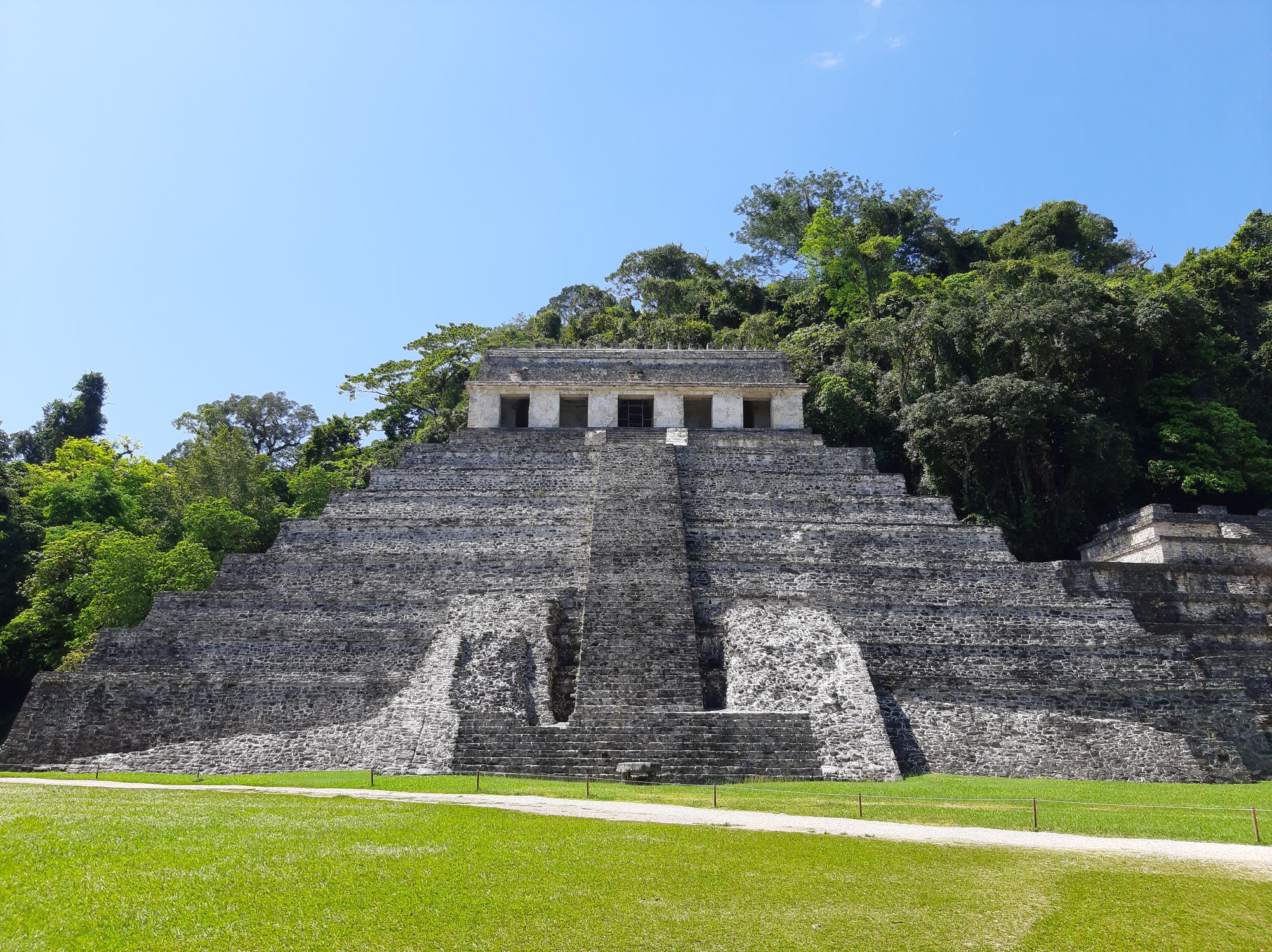
It must be said that it’s extremely difficult to easily translate the workings and significance of the Long Count Calendar to “Western terms.” Not only is the Long Count an extraordinary display of early civilization (it’s thought to be one of the earliest recorded examples of the “zero concept”), it’s mathematically complex. The Long Count is also a vestige of a civilization that time wasn’t kind to: the Maya civilization peaked in the 10th Century C.E., and the era of Spanish colonization spelled genocide and destruction for countless historical records.
With that in mind, one would hope that discussions around the Maya Long Count Calendar were based in sensitive understanding of Mesoamerican culture, the atrocities they historically and continue to suffer, and the vast language barriers across time and continent. Wouldn’t that be nice?
A Fuzzy Read
In the middle 1960’s, the world order was careening toward crisis. America’s involvement in a sadistic military conflict in Vietnam was prompting mass-protests, structural racism was becoming more visible in settler countries, colonialism was being violently rejected across the globe, and environmental movements were sounding alarms. No longer fettered by American global supremacy, the Soviet Union was flexing its geopolitical reach. Ideas of the apocalypse became embraced by religious and New Age believers alike, providing an answer to a world mired in chaos.
It was in this context that the popular misreading of the Long Count Calendar’s 13th b’ak’tun took hold. Michael D. Coe was an archaeologist whose career began in the 1950’s in Taiwan. Working at a front organization as a CIA propagandist trying to subvert the Chinese Communist Revolution, Coe learned Mandarin and studied local ethnography. Coe took these wholly benevolent credentials to Central America, where he spent years conducting field research before the publishing of his 1966 book “The Maya.” In that book, Coe asserts…
“There is a suggestion … that Armageddon would overtake the degenerate peoples of the world and all creation on the final day of the 13th [bʼakʼtun]. Thus … our present universe [would] be annihilated … when the Great Cycle of the Long Count reaches completion.”
There’s some undeniably impressive work and research in “The Maya,” and it’s safe to assume that Coe was genuinely fascinated by Mesoamerican culture. Yet this passage is striking for two reasons. One, it’s unclear from my research that Coe provided any relevant evidence for this claim. Two, Coe’s use of the phrase Armageddon speaks to a wildly myopic, Eurocentric understanding of global cultures, one that an archaeologist would hopefully be able to grasp.

Armageddon is a Judeo-Christian reference, and it’s likely that Coe (whose great-grandfather co-founded Standard Oil) grew up on his 400-acre Oyster Bay estate with an understanding of Armageddon’s Christian connotations. The fiery imagery of horsemen and a lamb with seven horns and seven eyes (a detail most definitely concocted by a mushroom-tripping priest) has intense emotional resonance for so many in “Western” countries.
In the United States, where religious zealotry, tax evasion, and the Enlightenment joined hands to form a new nation, the end of the world is less a fear than an expectation. Racist, crazy, “Woke,” or wealthy, if you’re an American you’ve probably thought about how you’d survive the end of the world. As opposed to indigenous peoples who’ve experienced world-ending scenarios, or nations who are the target of superpower bombing campaigns, the American apocalypse is more the subject of libertarian romanticization. Something that you deserve is going to be taken from you. This will give you anger. The anger will give you purpose, something your bland, industrialized life can’t provide.
Couple this with a fetishization and fear of those whose land on which you’re squatting. Coe’s interpretation of b’ak’tun twists Mesoamerican culture to fit his preconceived notions. The Long Count Calendar doesn’t “end” in 2012. Some calendars throughout Mesoamerican cultures predict the celebration of kings in 4772 C.E., a year most of us won’t live to see. The ba’k’tun calculations aren’t even settled! Coe’s first Julian reading had him speculating the 13th as ending on December 23rd, 2011. A fourth edition of Sylvanus Morley’s The Ancient Maya revised this to December 21st, 2012 in 1983, underscoring the laughable impeachability of these “predictions.”
Still, as the decades pressed on, Coe’s misunderstanding grew in prominence. In the United States, the doomsday theory reached fever pitch in the mid-2000’s, as the depiction of indigenous peoples as “otherworldly” coincided with an opportune moment for entertainment.
Edu-Tainted
By the mid 2000’s, media companies were conglomerating en masse. In the world of television, A&E Networks, who owned the History Channel, purchased Lifetime Entertainment Services in 2008. Lifetime was a very different brand from the History channel, but it made money, and television was changing. That same year (and probably not coincidentally), the History Channel went through a rebrand, shedding its old stuffy logo for…one that looked pretty much exactly the same, and renaming itself “History.” “Adventure-seeking is in,” said executive vice-president Nancy Dubuc. “Sitting in an armchair telling war stories is out.”
It was around this period when History and Discovery’s most head-smashingly inaccurate 2012 Doomsday specials were produced and aired. Beginning with the History Channel’s Decoding the Past: Mayan Doomsday Prophecy in 2006, History and Discovery would provide nearly wall to wall “2012” coverage for the next several years. This peaked in 2009 with such glorious content as 2012 Apocalypse, Seven Signs of the Apocalypse, and the series Nostradamus Effect.
Linking 16th Century French astrologer and prophesier Nostradamus’s work to the 2012 theories was relatively easy. Since the publication of more of his work in the 1980’s, Nostradamus’s “The Prophecies” have become incorporated into the Doomsday lexicon. While it’s tempting to see Nostradamus’s many cryptic predictions as having pertinence to world events, the vast majority of quoted predictions were published decades after Nostradamus’s death, and many after the events they purportedly foretold. Nostradamus himself made it quite easy; his “quatrains” don’t offer a single date to attach to the event he’s foretelling.

This constant 2012 content was personally destabilizing. As someone who spent the majority of their childhood watching television, I remember the feeling of apocalyptic panic when I’d turn on History Channel to see a CGI graphic of an asteroid hitting Earth, a dramatization of the wise, bearded Nostradamus writing on a scroll, or a terribly racist cartoon version of indigenous music playing behind quick, desaturated shots of “spooky” Maya artifacts.
I was convinced that my life was over; that I only had a couple of years left before the end of days was upon me. Even as my development shifted my anxieties, and the apocalypse became less important than Bob Dylan and passing Algebra, there was always the nagging feeling that December of 2012 would spell the end.
The end of the 2012 doomsday phenomenon would be both a bang and a whimper. Seeing the gluttonous ratings return on the apocalypse hype, schlock impresario Roland Emmerich released 2012 in 2009. This god-awful disaster movie pulled out all the Hollywood stops to present CIA-core Michael D. Coe’s dimwitted doomsday fantasy in stunning, $200 million resolution. The film was so successful that executive producer Mark Gordon voiced the idea of adapting a sequel into a series for ABC. From his perspective, ABC “will have an opening in their disaster-related programming after Lost ends…people would be interested in this topic on a weekly basis.”
I wish that I could reach back in time and tell my kid self that all this fear and foreboding was so hollow. I wish I could tell them that this was at best a stupidly insensitive mistranslation and at worst motivated purely by profit. History Channel and Discovery Channel knew that children at least represented a potential market for their content. They sold this fear anyway, pounding the end of days into the heads of their audiences relentlessly as a product. Nancy Dubuc claimed that the History Channel of the mid-to-late 2000’s was all about “adventure-seeking.” I wholeheartedly agree, as long as Dubuc was describing seeking profits without any regard for reality or potential consequence.
At its most concentrated, the 2012 doomsday coverage on History Channel and Discovery Channel was an addictive viewing experience. After all, if the world really is going to end on a specific day, then the only thing one can do is be informed. I have a similar, contemporary relationship with Climate Change coverage. I don’t want to know about every single disaster engulfing every corner of the planet. Yet isn’t it my responsibility to know?
Funny Feelings
This is where the politics of “doomerism” become especially salient. We’re all familiar with the most fanatical examples of apocalyptic belief (Seventh Day Adventists, Heaven’s Gate, Waco), yet the apocalypse is also big business for “tasteful” people we like to celebrate. Bo Burnham’s song That Funny Feeling from his 2021 special Inside includes the line, “20,000 years of this, and seven more to go.” Adam McKay practically rounded up the entire Liberal Elite to scream about the end of days in Don’t Look Up.

I don’t disparage these artists for employing apocalyptic rhetoric to underscore their feelings. Adam McKay almost immediately went on a defensive PR campaign to explain his noble intentions for Don’t Look Up…and I’ll go to my grave defending Step Brothers. While I was disappointed by Burnham’s failure to make a cohesive statement in Inside, I myself have thoughts like that all the time. Hell, I write lyrics like that all the time!

However, in researching this piece, it strikes me that the idea of the apocalypse is particularly American. With her tanks and her bombs, America ends things. America “ended slavery.” America “ended” the Second World War. America “ended” the Cold War. And even as good Leftists intent on dismantling the systems in which we’re so helplessly involved, we’re contented by the inevitability of it all, as if the God of the turbulent 20’s will smite us in one fall swoop, absolving us of culpability. We know this isn’t true. We won’t be the last generation, even if in our hubris, narcissism, and reluctance to change, we become the last comfortable one.
The Long Count Calendar doesn’t include a bloody battle on Armageddon between the forces of “good” and “evil.” The Long Count Calendar doesn’t even imply an end. Like Howard Zinn in the opening of A People’s History of the United States, I’m wary of the connotations that come with glorifying an indigenous culture, as if peoples must reach some sort of zenith to justify the avoidance of genocide. While I recognize the utter atrocity of colonialism, part of me wishes that the ancient Maya could have seen the utter incompetence of the “civilized” colonizers who so egregiously misinterpreted their work. And all of me hopes that people everywhere will be alive and celebrating in 4772.
In doing research for this article, I forced myself to rewatch some clips of Nostradamus Effect from 2009. I couldn’t get over how ridiculous they were. The talking points became so circuitous that I just tuned out and started chuckling to myself about the Chappelle Show’s inimitable and unmentionable Nostradamus send-up. Romanticizing the end times is so silly. Dealing in the now times is much more pressing work.
So to all my friends who thought they were toast on December 21, 2012, and to all my friends who are worried about the end times, I can’t tell you that hard times aren’t ahead. But rest assured, times are ahead. And tonight, I’m gonna party like it’s 4772.
Were you afraid of the December 21 2012 end of the world? Let us know your stories in the comments!


Leave a Reply