

This article was written by The Zillennial Zine’s spring editorial intern Henry Ryeder. Find him on Instagram at @henryryeder. If you would like to share an article with The Zillennial, send us an email at thezillennialzine@gmail.com.
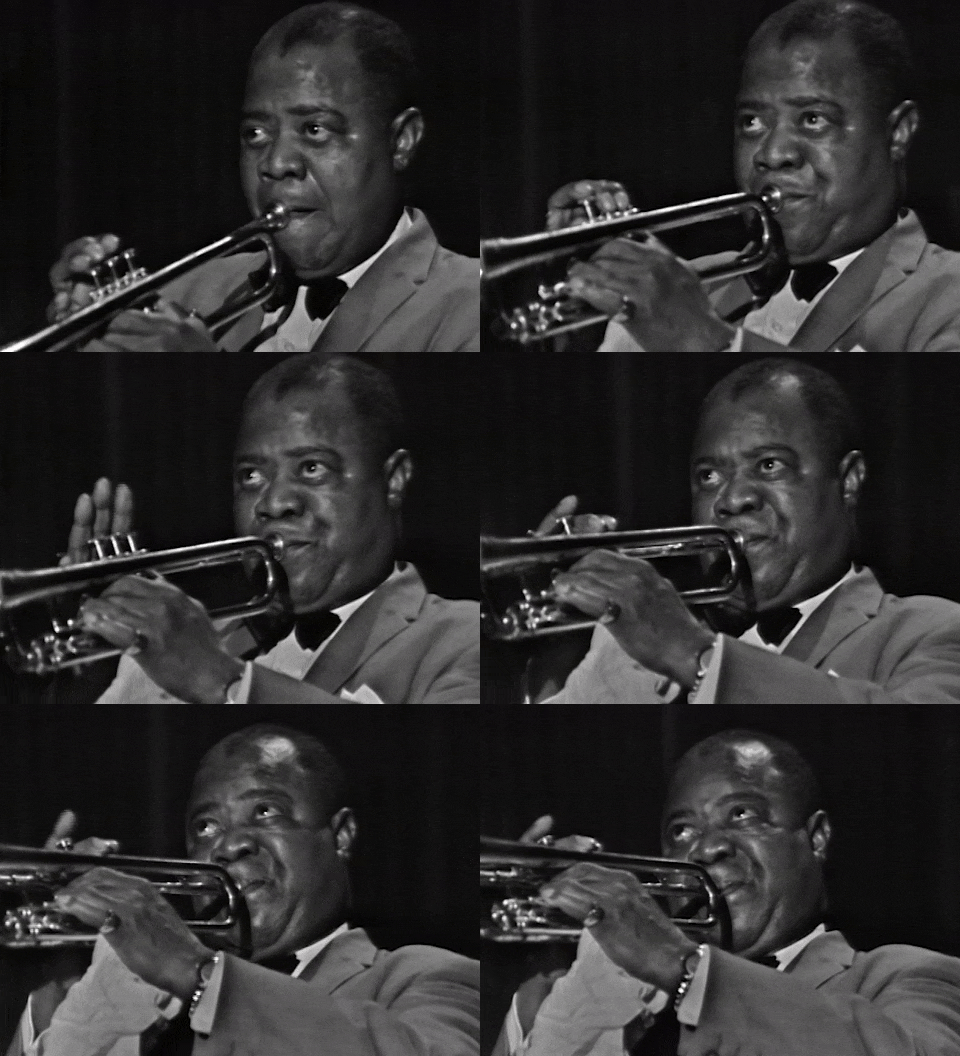
The legend goes that Louis Armstrong wasn’t allowed inside the recording studio during his first session in 1923. Not that Louis’s cornet wasn’t heard on the album; rather Louis was forced out of the room precisely because it was heard too much.
This was before tape, and in the acoustical recording days, all tracks had to be cut live through a single brass horn making impressions on a wax cylinder. If a player overpowered the other, it would show up on the finished product. There were no tracks to mix and no EQ functions to tamper. What you got what was what you got, and Louis Armstrong knew sure that he was going to give. Armstrong’s power on the trumpet was so overpowering that he was instructed to stand in the hallway and play, so as to balance better with the rest of the band. How’s that for live mixing?
Jazz has always fought constrictive definitions. In its mammoth century-and-a-half journey, jazz synthesized Black American and Creole folk music in New Orleans, utilizing the variety of instruments in fashion in the Late Romantic Era. It got its name from the scent carried by sex workers in the French Quarter (jasmine perfume, shortened to jazz), conquered the nascent recording industry, and blossomed into America’s first mass-produced cultural export.
Jazz birthed not only thousands of popular music’s most beloved icons, but every single pop genre that would follow. Then, as slowly and coolly as it had swung onto the tiled floor of American consciousness, it receded into the background, brimming the smoke-filled clubs and effete lecture halls of towns and cities all over globe.
Jazz is no longer reviled by the socially conservative columnists of vanguard newspapers; it no longer strikes fear into nice White parents and angry White men. After rock, metal, hip-hop, and bisexuality, the American Middle Class have found plenty of other topics-du-jour to keep them up at night, absorbing jazz (or at least the most reductive, toothless version of it) into the realm of acceptability.
Yet it’s still around us, permeating not just aficionado spaces, but the musical minds of each generation’s most trailblazing artists. And as a more accurate telling of American history has emphasized the importance of Black culture, jazz has remained the hallmark of all that is good about America: heart, adaptability, and excellence in the face of doubt. More than a century after the first jazz record was pressed by a group of white musicians, jazz continues to remind us why American history is Black history, and why American music is Black music.
But what about its purpose to our daily lives? I’d wager that most of your relationship to jazz is functional: you put it on when it fits “the mood.” This is just as valid as any reason to appreciate one of the world’s greatest musical gifts. While jazz is full of raucous fervor, some of its best moments are serenely intimate. After all, even Louis Armstrong had to stand 15 feet from the horn to match the vibe. So here are the top 10 jazz albums for your rainy day.
10. Earl Klugh Trio – Volume 1
The Earl Klugh Trio is a remarkable concoction, and one with which I’m greatly familiar. In 1991, renowned guitar prodigy Earl Klugh brought together two other champions of the contemporary jazz scene: bassist Ralph Armstrong and drummer Gene Dunlap. Armstrong, a lifetime power player, beat out wunderkind Jaco Pistorius for a spot on the George Martin-produced Mahavishnu Orchestra. Dunlap also worked with guitarist Grant Green and vibraphonist Roy Ayers.
The resulting effort is a delectable record of standards, sweetly shuffling between virtuosic solos and harmonic beauty. I grew up listening to this album, and some of my favorites were The Love Theme from Spartacus and the trio’s playful rendition of I Say A Little Prayer.
9. Koop – Koop Islands
The third album from the Swedish electronic duo Koop was a favorite of mine throughout college. Effortlessly blending vocal jazz with percussion samples to deliriously sweet heights, the album opens with the mysterious Koop Island Blues.
Koop Island Blues begins with a kick and brush rhythm as its keys and vocals envelop you. The album reaches a peak with Strange Love, still one of the most beautiful songs I’ve ever heard.
8. Various – When Jazz Meets Brazil
Yes, Bossa Nova is its own source of dissertations, and this compilation record isn’t the most famous example of Bossa Nova in the United States. That title would undoubtedly belong to Joāo Gilberto and Stan Getz’s Getz/Gilberto, a record that brought Brazilian Jazz into American homes and incited a mid 1960’s Bossa Nova “craze.”
Yet the sheer breadth of Bossa is too much to contain in one artist’s sleeve, so this compilation record from 2000 will do the trick. Among the highlights are the famed Antōnio Carlos Jobim’s Tereza My Love, as well as supergroup Weather Report’s Jungle Book.
7. Regina Carter – Rhythms of the Heart
Jazz violinist Regina Carter might not be the obvious choice for this list, but her superhuman command of her instrument is reason enough to place this record at #7. I can’t guarantee that you’ll find Regina’s silky, prodigious violin bows relaxing, but they’re certainly entertaining.
Among the highlights on Rhythms of the Heart from 1999 is the lean and mean rendition of Kenny Barron’s New York Attitude, as well as her unbeatably swinging take on Lewis Nash’s Skeeter Blues.
6. Chet Baker – Chet Baker Sings
Chet Baker is an icon, and Chet Baker Sings is the record that made him one. A world-class trumpeter with a remarkably bright baritone voice, Baker also benefited from looking damn good while doing all of it.
Chet Baker Sings from 1955 is a testament to the utter cool of 50’s Beatnik style, as well as the changing of jazz’s old guard to the new. Among the highlights are Baker’s starry-eyed I’ve Never Been In Love Before, and his My Funny Valentine, perhaps that standard’s most famous recording.
5. Duke Ellington – Far East Suite
Duke Ellington needs no introduction. A first rate pianist, composer, and orchestra leader, Ellington was at the forefront of jazz from the beginning of his career in the 1920’s through to his death in the 1970’s.
Ellington’s “Far East Suite” from 1967 is no exception. Inspired by his group’s tour through Asia, Far East Suite includes some of the strangest, most beautiful compositions in the Duke’s repertoire. Among the top tracks are Ellington’s Isfahan (which became a standard) and the slow-burn Agra.
4. Marta Sanchez Quintet – Partenika
I had the privilege of stumbling across Marta Sanchez’s group in Brooklyn a couple of years ago at Barbés. Sanchez’s compositions, led by her piano, are nothing short of texturally magnificent. You can feel the music move from side to side, almost as if it’s beckoning you to notice something that is (deliberately) out of place.
Partenika is a fantastic record, and some of my favorite tracks include the questioning Balada Del Momento and the playful Small Game.
3. Herbie Hancock – Maiden Voyage
Herbie Hancock is another jazz legend. A pioneer of the Fusion era, Hancock’s dynamic piano virtuosity and engineering prowess allowed him to hone the relatively new Rhodes electric piano and Hohner clavinet with zeal. Yet 1965’s Maiden Voyage sees the soon-to-be fusion icon playing the grand piano, testing the waters across the expansive sea of swing in a portent of things to come.
Maiden Voyage shows where Hancock was going, while putting on full display the influences that impacted his style. Among the highlights are the bopping Survival of the Fittest and the contemplative Little One.
2. Charles Mingus – Mingus Ah Um
There are few greater composers in jazz history than Charles Mingus. A bassist and pianist with a penchant for collective improvisation, Mingus composed and performed some of the most exciting pieces in mid-century “Post-Bop” jazz. Notoriously mercurial, Mingus’s soul pours off his 1959 Mingus Ah Um, exploding and receding with equal gravitas.
Among the highlights are the soulful Self-Portrait in Three Colors as well as the percussive Fables of Faubus.
1. Miles Davis – Kind of Blue
Often heralded as the greatest jazz record of all time, Miles Davis’s 1959 record Kind of Blue is a resolute masterpiece. Recorded at CBS 30th Street Studio and featuring a monster lineup (Bill Evans on piano, “Cannonball” Adderley on alto saxophone, and John Coltrane on tenor saxophone, to name a few), Kind of Blue sees Davis experimenting with modality and harmony in invigorating ways.
Influential on nearly every jazz musician and any musician who listens, Kind of Blue isn’t just one of the greatest albums of all time, it’s a perfect rainy day jazz record. Among the best cuts on Kind of Blue are Freddie Freeloader and the watery shuffle Blue in Green. However, I highly recommend a full listen.
What are your favorite rainy day activities? Do you have a favorite jazz album or artist? Leave a comment below!


Leave a Reply