

This article was written by The Zillennial Zine’s spring editorial intern Asa Conroy. Find them on Instagram at @asakayconroy. If you would like to share an article with The Zillennial, send us an email at thezillennialzine@gmail.com.
I love editing. It’s not much of a surprise because I love combing through long paragraphs and trimming them down or even laughing at my own spelling mistakes. I know for some it’s practically horrifying to see one mistake after the other, but editing can be fun. It doesn’t matter whether you’re self-editing your own novel or just another essay for school, there are plenty of tricks to ease the cringe off incomprehensible sentences. So, here are some of my favorite tips and tricks on how to get better at editing and find the joy in it!
One Step at a Time
Usually when I see people get nervous about editing, they always see the big picture. It’s overwhelming. There are too many possible mistakes that one may imagine and that they need to get it all done at once. But that’s not the case. There are several different types of editing, the number always seems to change depending on who you ask or what you’re focusing on. There’s proofreading, line editing, developmental editing, structural editing, stylistic editing, copy editing, sensitivity reading, beta reading, and even more. While many of these cooperate and overlap, it doesn’t mean that your work needs to do the same
Take a deep breath and decide which one you need to start with and build. Your style is your own, so I won’t tell you to start small or go big. I suggest working with your strengths. I have friends who can breeze through 30 pages in a few hours and pick out every missing comma and period. I also have friends who need to spend a solid minute on each word to make sure it makes sense. They’d miss everything if they tried to swap styles. Consider organizing where you’d like to start and what works best for your writing and build from there. You don’t need to get it all done at once. You just need to take it one step at a time, at your own pace.
Create in Other Ways
This one may work better for creative works, but I’ve found that it can work for academic writing occasionally. Editing is as much a form of creation as writing is, you’re creating your story or your essay even when you’re chipping away. You’re creating the final product. However, if you find yourself stuck, you could try creating the project in other mediums to home in on how you want your final product to appear. It may offer new perspectives to explore and give you a fresh look on what you have already written.
Creating a playlist of songs that remind me of a subject always helps. I have playlists for my characters referencing their personalities, relationships, important events, and arcs. I also have study playlists for the most unbelievable subjects, I still can’t listen to “Never Too Late” by Three Days Grace without remembering my 8th grade book reports. Things like outlines, presentations, or flash cards lean more academic, but could be creative as well. Drawing your settings or characters always create a wonderful visual. Alternatively, building/creating in The Sims or similar properties can help visualize subjects. Picrews and online dress up games might seem like every non-artist’s savior nowadays. Any method that keeps your creative juices flowing, is a good method.
RPG to EDIT
This sub-heading is cleverer if you spell out the capitalized words. This method “gamifies” your editing experience. If you’re unfamiliar with gamification, it means to turn something into a game so that it’s way more fun. Our teachers and healthcare professionals have been doing this for years, so why not try it for yourself? It makes sense, doesn’t it? So many people view editing as this big, scary monster. It’s up to you to become the brave hero who slays the beast and saves the town.
Start by assigning yourself some Health Points (HP). Let the number match your confidence. If you’re not feeling particularly brave, aim high. Your HP will restore each page, but what brings it down? Your errors. You could either treat each error like an attack or assign it a monster. Like filler words are slime and spelling mistakes are bats. Each error takes away from your HP. However, any edits that do not fall under an attack/monster type you gain HP. Once you’re done, see how many points you have left. If you were defeated, start back at the top and try again. Once you’re done you could restore your HP with a break.
Editing Bingo
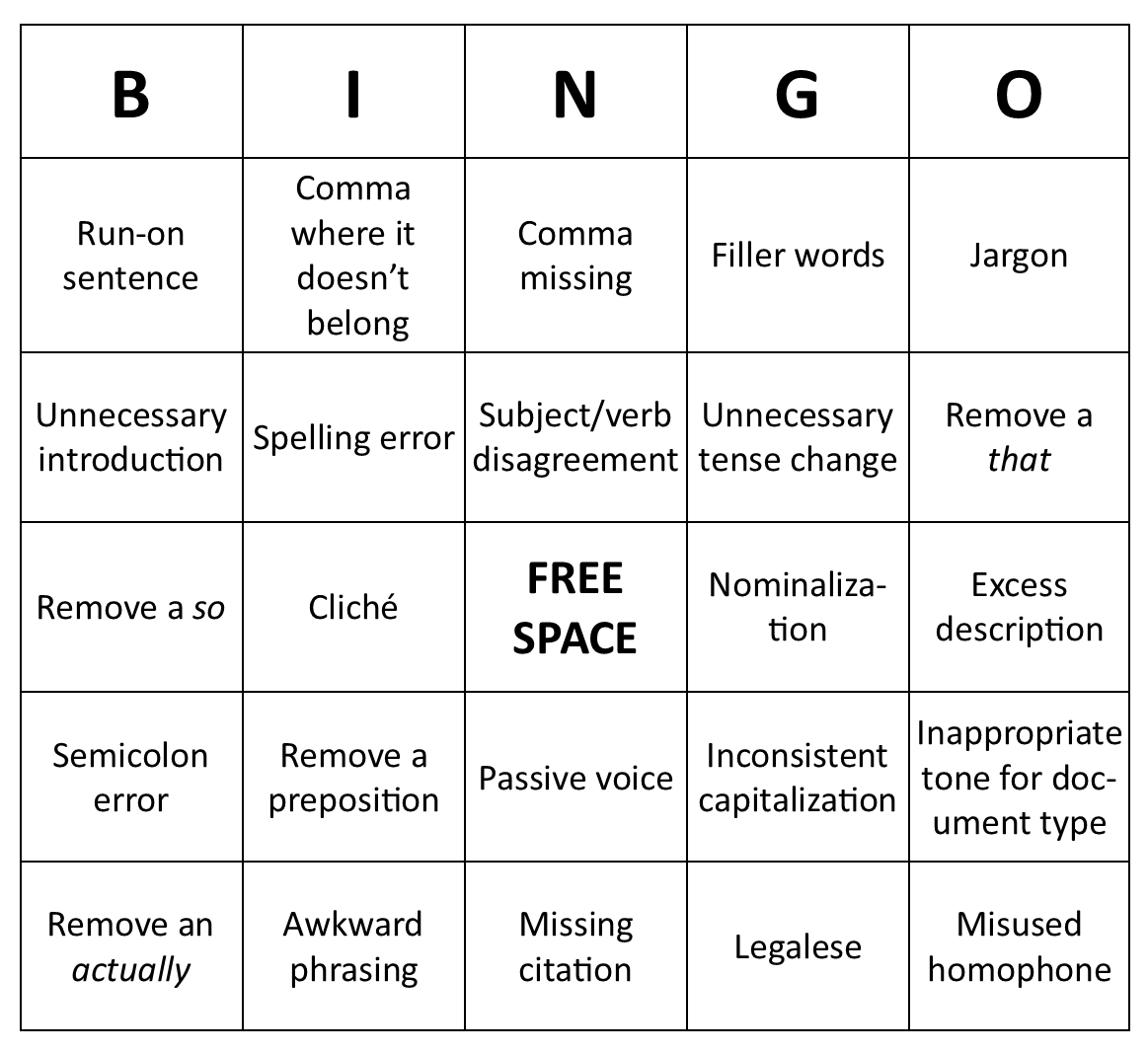
Like the RPG, this is another game to play. Draw up a Bingo card with common errors and opportunities to improve. Focus on the ones you struggle with the most, and then throw on some wild cards. You may not think you make those errors, but we always can surprise ourselves with the mistakes we can make. If you’re not sure where to start, here is a sample from WordRake, along with other games. Simple rules: you can only cover a square once and you should take a break after. Breaks are always necessary. Additionally, you can reward yourself with a job well-done.
Are you ready to play? Once you have a prepared Bingo card, set up your editing session. You could do this with a timer or simply edit until you tap out. Make sure your editing marks are clear because once you’re finished, you’ll be going over everything to check off each square. Highlighters or tracking helps changes stand out. I’m sure you know the rules of bingo, if you get five in a row/column you win! If you don’t, oh well at least everything’s edited. If you get blackout bingo (full board), wow.
Tally and Reward
This game is like Bingo, but you can repeat you marks and there is only one winner. Again, you’ll want to gather any errors or improvement opportunities. Instead of covering squares, you’ll be counting the number of times you find them in your writing. Once you’re done you can reward yourself for the category you fixed the most. Each category should have its specialized reward. Technically, you’ll be rewarding yourself for all your hard work, but the specific prize is determined by your categories. So, you won’t know what you get until you edit!
Let’s say in this editing session you’re looking for spelling mistakes, misplaced commas, and inconsistent capitalization. But before you begin you assign yourself the rewards of a new shirt, baking cookies, or your favorite movie in that order. You end up tallying 4 spelling mistakes, 6 misplaced commas, and 2 inconsistent capitalizations. Commas won, so you get cookies. It would be fun to eat them while watching your favorite movie in your new shirt, that’s not the game. Although, remember this is how to get better at editing, so don’t make mistakes just cause you want cookies.
Read Out Loud (Voices Encouraged)
Reading out loud is one of the oldest tricks in the book on how to get better at editing. Which is good because it really helps. Sometimes things make sense when we first write them, but sound strange once we reread them. When we read and speak simultaneously, we focus more on what is in front of us. That may be specific words, certain phrases, or entire paragraphs. When you read your writing audibly, make note of any “umms,” “uhhs,” any confusion, or any time your tripped over your words. That could signal the need for editing or rereading. Doing this a couple times weeds out any verbal mistakes and writing mistakes.
It also helps to get into character, if you can. This may or may not work on an academic piece, but that all depends on how well you think you can act out your sources. It is always effective in a creative setting. Each character has their own purpose or personality. You may find that reading aloud can highlight who actually matters in that scene and who’s reacting appropriately. For example, if a brave character is afraid for seemingly no reason you could either omit their fear or use it to reveal something deeper. For both errors and characters, accents are as effective as they are fun. You’ll have to focus on each word, but also see how well it fits because a New Yorker doesn’t speak like someone from England.
Challenge Yourself!
Challenges like these or the many others out there are good for keeping things exciting. You’ll never know the editor you can become until you challenge yourself. You can try all these tips and tricks, borrow famous ones like E-Prime and Lipograms, or create some yourself if you’re feeling adventurous. Editing takes time and practice, but it doesn’t mean the time you spend doing it has to be boring and serious. Take all the time, practice, and challenges you can and find the joy in editing. Before you’ll know it, you won’t need my advice on how to get better at editing.
Do you have any advice on how to get better at editing? Let us know in the comment section below!


Leave a Reply